After a decade managing Google Ads accounts as a Google Premier Partner, the same ten gaps show up in nearly every account we audit. WordStream's 2026 benchmark report puts the cross-industry average cost per click at $5.42, up from $5.26 last year. Legal services sit at $9.87. Home improvement at $8.33. Real estate posted the biggest annual rise: CPCs up 27.27%. The macro picture is simple. Auctions cost more, click intent is roughly flat, and every dollar of wasted spend costs more than it did twelve months ago. The cheapest defence against rising CPC is the boring account hygiene that most in-house teams haven't touched in over a year.
This is the agency playbook for Google Ads, ranked by what actually moves customer acquisition cost. Most of it is unglamorous. That is the point. We have managed $12m+ in ad spend across Australian brands that have gone on to $1.2b+ in combined exits, and the order of operations below is what we run on the first ninety days of every new account. It sits inside the wider performance marketing programme we run for clients.

The 2026 backdrop in three numbers
Search ad costs have risen for five consecutive years. The 2026 WordStream report shows CPC up across most industries year on year, with the average sitting at $5.42 cross-industry. Performance Max now drives an estimated 45% of all Google Ads conversions (industry data, early 2026). AI Max for Search moved out of beta in April 2026, and Google has confirmed Dynamic Search Ads campaigns will auto-upgrade to AI Max starting September 2026.
Three things follow from that. Wasted spend is more expensive. More of your inventory is going through formats that hide the conversion path. Defaults are quietly migrating you onto AI-managed surfaces whether you act or not. The tips below address each of these in priority order.
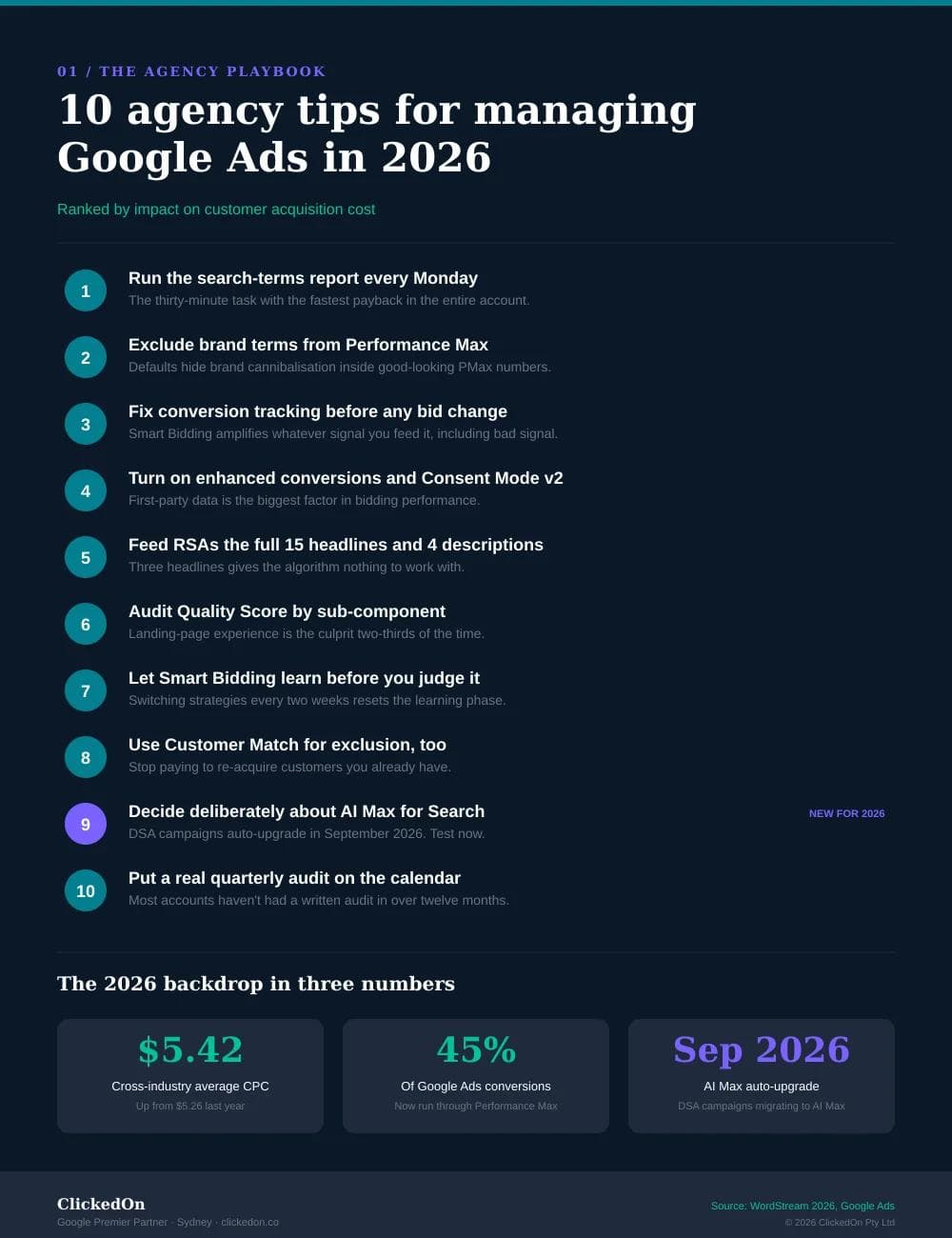
The 10 tips, in order of CAC impact
1. Run the search-terms report every Monday
The single highest-ROI thirty-minute task in any account. Open the search-terms report for the past seven days, sort by cost, and add anything irrelevant as a negative keyword. The accounts we audit that have not touched negatives in sixty-plus days are consistently the worst-performing. We have inherited accounts where wasted spend on irrelevant queries was running into four figures a month. If you are doing nothing else on this list, do this.
A note on broad match. Broad campaigns will trigger queries that look weird in the report but are working in the data. Some leniency is warranted. But you know your business better than Google's matching algorithm does, especially for lead-gen. Be ruthless with brand-safety negatives, location negatives, and category mismatches. Be patient with the rest.
2. Exclude your brand terms from Performance Max
This is the tip some readers will disagree with. The Google account-rep position is that Performance Max should be free to bid on brand terms because "incrementality". In practice, on every account we have audited, PMax with brand inclusion cannibalises the brand-search campaign, claims credit for conversions that would have happened anyway via organic or direct, and quietly inflates blended CAC while looking great in the PMax dashboard.
Use the brand exclusion list at the campaign level. Google rolled this out as a self-serve PMax control in late 2024, and it now applies to Search and Shopping inventory. If you are running Shopping through PMax and worried about losing branded product searches, segment by SKU intent first. For most accounts with brand exclusions in place and 30+ monthly conversions, PMax earns its budget on non-brand inventory. Without exclusions, the numbers lie. More detail in our Performance Max guide and when to use PMax write-ups.
3. Fix conversion tracking before you touch any bid strategy
Smart Bidding is only as good as the conversions you feed it. Before changing one bid strategy: confirm GA4 is firing on the right events, server-side tagging is live if you have got meaningful cookie loss, and enhanced conversions are switched on inside Google Ads. We have audited accounts running Target CPA with broken conversion tracking. That is automation amplifying noise at scale, and it is the most expensive mistake in the category.
If you cannot say with confidence what your last seven days of conversions look like and where they fired, you are not ready to change a bid strategy. Fix the signal first.
4. Turn on enhanced conversions and Consent Mode v2
First-party data is now the single biggest factor in bidding performance. Third-party cookies are functionally dead in most browser contexts, and consent rejection is eating an increasing slice of attribution. Enhanced conversions sends hashed first-party data (email, phone) back to Google so the algorithm can recover signal lost to consent and browser restrictions. Consent Mode v2 is required for EEA traffic and is good practice for Australian advertisers running any campaigns into Europe.
If you are running Shopify or HubSpot, both have native integrations that make this a 30-minute setup. There is no good reason an account in 2026 is running without it.
5. Give Responsive Search Ads enough creative to actually test
RSAs assemble headlines and descriptions dynamically. Feeding them three headlines and one description is paying a chef to cook with one ingredient. Use the full asset allocation: 15 headlines, 4 descriptions. Pin one or two headlines if you have a non-negotiable brand or compliance line that has to appear in position 1. Then rotate the lower-performing assets every four to six weeks based on the asset-strength report.
RSAs underperform when operators starve the algorithm. The full fifteen headlines and four descriptions give Google room to find combinations a human writer would never test. Three headlines gives the algorithm nothing to work with.

6. Audit Quality Score by sub-component, not by the average
The "Quality Score" column at keyword level is a vanity metric. The useful audit is the three sub-components: expected click-through rate, ad relevance, and landing-page experience. Filter to keywords with QS below 6, sort by spend, and look at which sub-component is dragging. In our experience, landing-page experience is the culprit roughly two-thirds of the time. Which means the actual fix lives on the page, well outside the Ads UI.
This is the moment many in-house operators get stuck, because fixing landing-page experience needs CRO and dev time that is not theirs to allocate. Push the audit upstream anyway. Show the data. "This keyword spent $X last quarter at a QS of 4 because the landing page is throwing a soft-404 on mobile" is a conversation that gets traction in budget meetings. For the page-side fix, see our conversion rate optimisation write-up.
7. Let Smart Bidding learn before you judge it
Smart Bidding works. Impatient operators do not. Google's documented minimum for Target CPA is 30 conversions in 30 days at the campaign level. For Target ROAS on Search, it is 15 conversions in 30 days, although accounts tend to stabilise better above 30. Below those thresholds you are running automation on noise, and the bid strategy is being blamed for problems it cannot solve.
If your conversion volume is under the floor, you have three options: consolidate campaigns to pool conversion signal, switch to Maximise Conversions (which has a lower threshold), or stay on Manual CPC until you have the data. What you cannot do is switch strategies every two weeks. Every change resets the learning phase and burns budget on the next two-week reset.
8. Use Customer Match for exclusion as much as for targeting
Connect your customer data via the native Shopify, HubSpot, or Salesforce integrations, or upload manually. Most operators think of Customer Match as a targeting tool. The bigger value, in our experience, is the exclusion list: stopping PMax and acquisition campaigns from paying to re-acquire customers you already have. Our audience targeting deep dive walks through the full pattern.
For lead-gen accounts without direct sales revenue, Customer Match also feeds the bidding algorithm a cleaner signal than form-fill conversions alone. The model learns what a closed-won customer looks like, instead of optimising blindly toward whoever happens to complete a lead form. That is the difference between optimising for pipeline and optimising for noise.
9. Decide deliberately about AI Max for Search
This is the new one for 2026. AI Max for Search moved out of beta in April. Google has confirmed that campaigns using Dynamic Search Ads, automatically created assets, or campaign-level broad match will auto-upgrade to AI Max in September 2026. Google's own data says AI Max delivers 7% more conversions at similar CPA/ROAS when the full feature suite (search-term matching, text customisation, final URL expansion) is enabled.
The honest read is that AI Max is good for some accounts and risky for others. Accounts with strong conversion data, clean URL structures, and solid landing-page coverage will benefit. Accounts with patchy conversion tracking or URL hygiene will find AI Max sending traffic to pages that should not be in the auction. The agency tip: do not wait for the September auto-upgrade to find out. Run a one-click experiment now while you still have the manual control to switch back.
10. Put a real quarterly audit on the calendar
A proper audit means a written list: conversion tracking, negatives, ad-copy assets, PMax exclusions, audience signals, landing-page experience, attribution model, account-level placement exclusions (the latter being a new control Google rolled out on 14 January 2026, which most accounts have not configured). Vibe checks do not count. If you do not have an internal practice for this, that is what our Google Ads management service exists for. Most of the accounts we onboard have not had a full audit in over twelve months, and the cost of that gap is usually four to six figures of recoverable spend.
Where these tips do not apply
Two honest caveats, because we have seen each of them undo an agency engagement.
Smart Bidding and Performance Max need conversion volume. If you are spending under $3K AUD a month with low conversion counts, several of these tips (Target CPA, PMax, Customer Match) are wrong for your account. Stay on Manual CPC or Maximise Conversions until you have the data.
And if your product or offer is the problem, Google Ads cannot fix it. We have audited accounts where the right recommendation was "stop spending and rework the landing page first". Honest agencies will tell you that. Less honest ones will sell you another month of management while the same problem keeps killing the conversion rate. The deeper question of when to bring in outside help is covered in our in-house vs agency piece.
Frequently asked questions
How often should I audit a Google Ads account?
A full written audit once per quarter. A search-terms review every Monday. A bid-strategy review when conversion volume changes meaningfully (a 20%+ swing in either direction, sustained for two weeks). Anything more frequent and you are resetting learning phases for no reason. Anything less and you are leaving recoverable spend on the table.
Should I exclude brand terms from Performance Max?
Yes, in nearly all cases. The exception is a brand new account with no existing brand-search campaign and minimal organic brand traffic. In every other case, exclude brand from PMax and run brand as a dedicated Search campaign. Your blended CAC will come down even though PMax CPA goes up. That is the correct trade.
What is AI Max for Search and should I opt in?
AI Max is Google's set of automation features layered onto existing Search campaigns: AI-generated assets, search-term matching beyond your keyword list, and final URL expansion. It is moving out of beta and will auto-upgrade DSA campaigns from September 2026. Whether you opt in early depends on conversion data quality and URL coverage. Run a one-click experiment in a low-stakes campaign first.
How much should I be spending on Google Ads management?
For accounts under $10K/month in spend, management fees should sit at 15 to 20% of spend. For accounts $10K to $100K/month, 8 to 15% is the typical range. Above $100K/month, fees usually move to a flat retainer or a tiered percentage. Be sceptical of anyone quoting under 8% on a small account. The economics do not work, and the service quality reflects it.
What is the most common mistake in Google Ads accounts you audit?
Broken conversion tracking running underneath an automated bid strategy. The campaigns look fine in the Google Ads UI. The CAC numbers in the boardroom do not match. Smart Bidding is optimising toward a conversion event that is either firing on the wrong page, double-counting, or missing the 25% of traffic that arrived through a privacy-restricted browser.
Is Performance Max worth running in 2026?
Yes, with brand exclusions in place, clean conversion tracking, and at least 30 conversions per month. Without those three conditions, PMax will quietly burn budget on inventory you cannot see. With them, it earns its place as the dominant prospecting format.
Key takeaways
- CPC is up, click intent is flat. In 2026, account hygiene delivers more recoverable budget than any new tactic.
- Search-terms report weekly. The thirty-minute task with the fastest payback in the entire account.
- Exclude brand from Performance Max. Default settings hide brand cannibalisation inside good-looking PMax numbers.
- Conversion signal first, bid strategy second. Smart Bidding amplifies whatever signal you feed it, including bad signal.
- Quality Score audits are landing-page audits in disguise. Fix the page, not the ad.
- AI Max auto-upgrades arrive in September. Run the experiment now, not in October.
Where to start
ClickedOn is a Google Premier Partner with a four-plus-year average client tenure. If you want a written audit that names the specific gaps in your account, ranks them by recoverable spend, and quantifies the cost of leaving them in place, book a free Google Ads audit. No deck. No commitment. Just the actual list, written by the people who would do the work.
If you want to dig deeper before you talk to us, our Google Ads management service page walks through how we structure the work, and the wider performance marketing programme page shows how Google Ads slots into the rest of the channel mix.