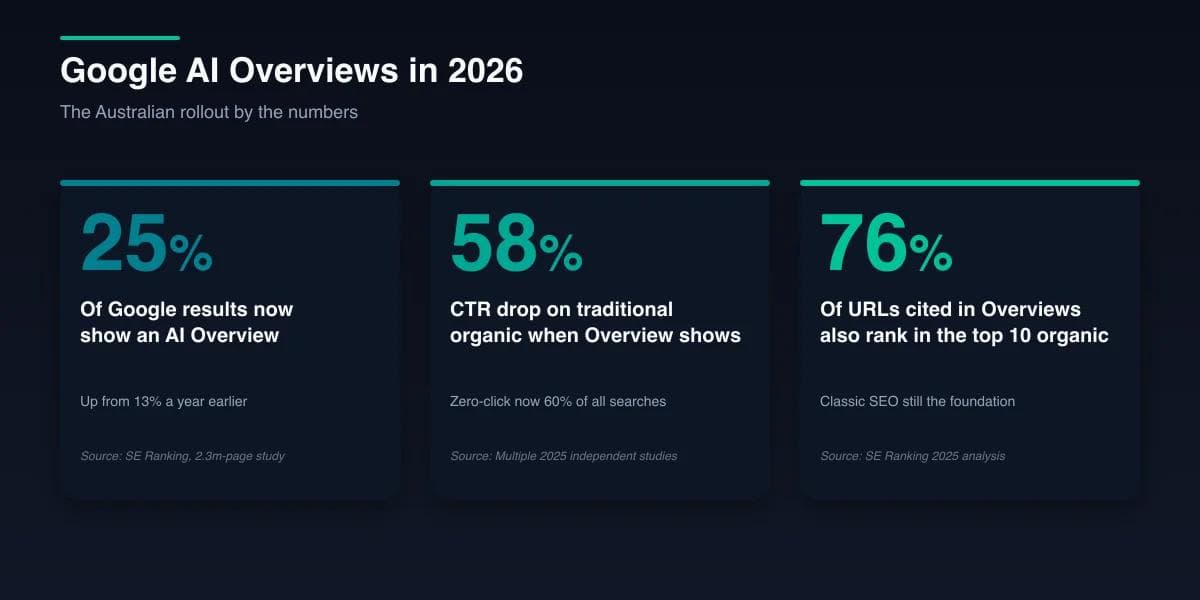
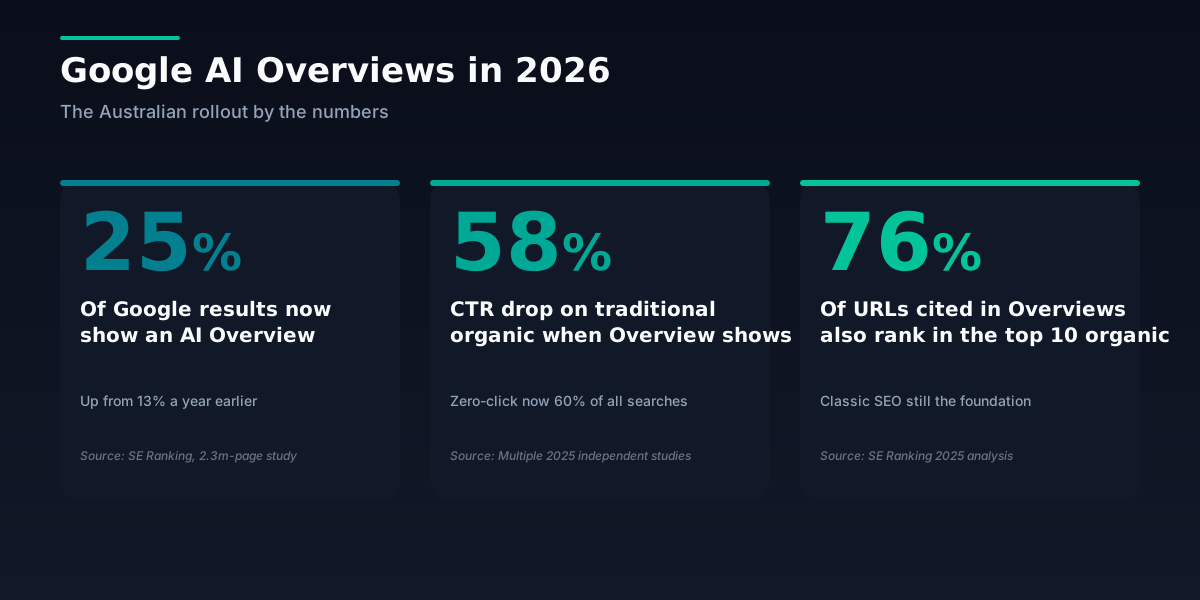
Google AI Overviews are the AI-generated summaries that now appear at the top of a growing share of Australian Google search results. They combine a generative answer with links to the underlying sources, sitting above the traditional 10 blue links. In 2026, roughly 25% of Google search results show an AI Overview, up from 13% a year earlier. When an Overview appears, click-through rates to traditional organic results drop by up to 58%. Around 76% of the URLs cited inside Overviews also rank in the top 10 organic results, according to SE Ranking, which means classic SEO and AI Overview optimisation are tightly linked but no longer identical disciplines.
For Australian businesses the practical question is straightforward: if your content is not structured for citation inside an AI Overview, you will lose a growing share of the Google traffic you used to earn. The good news is that the optimisation work builds directly on existing SEO foundations. The bad news is that most Australian sites are not yet doing it, which is both the risk and the opportunity. Our dedicated Google AI Overview optimisation service is built specifically for the Australian market.
What are Google AI Overviews?
Google AI Overviews are generative summaries produced by Google's Gemini model, triggered when Google's search systems decide a query is better answered with a synthesised response than a list of links. They typically include a paragraph or two of direct answer, a set of inline citations linking to the source pages, and a small handful of follow-up questions the user might ask next. Overviews appear above the organic results and above most ads, which makes them the most valuable real estate on the page.
Google first launched Overviews in the US under the name Search Generative Experience (SGE) in 2023. The feature was renamed AI Overviews when it moved out of Labs in 2024 and began rolling out to more countries through 2025. By early 2026, Overviews are live for Australian users across a large and growing share of informational and commercial queries.
What is the AI Overview rollout status in Australia?
Australian users have been seeing Overviews on a widening set of queries since late 2025. The rollout is not binary. Google controls exposure query by query, so the same business may see an Overview on some searches and not others. Informational queries ("what is generative engine optimisation", "how do I write a will") were the first to get Overviews. Commercial investigation queries ("best performance marketing agency Sydney", "SEO agency comparison") have followed. Transactional queries ("buy", "book", "quote") still mostly show traditional results, though that is slowly changing.
The practical implication for Australian businesses is that the exposure you get to Overviews depends on your mix of target queries. Businesses that rank for informational content (blog posts, guides, explainers) are seeing Overviews on a majority of their target keywords already. Businesses that target purely transactional keywords are seeing less impact today but should expect the pattern to catch up through 2026.
How do AI Overviews affect click-through rates?
When an AI Overview appears, the click-through rate on traditional organic results drops by up to 58%, according to multiple independent studies in 2025. Google's own framing is that the Overview adds value for the user (the answer is right there), and the remaining organic clicks are more qualified. Both things can be true. What matters for a business is the combined effect: fewer total clicks on the same set of queries, but the clicks that do happen tend to be more intent-rich.
The bigger shift is zero-click behaviour. Around 60% of Google searches now end without a click to any external site. AI Overviews accelerate that trend because they often give the user everything they need without requiring a visit to the source.
Against that backdrop, the only way to defend Google-sourced traffic is to earn citation inside the Overview itself. A citation inside an Overview is both a link and an implicit endorsement from Google's AI. It is the closest equivalent to a featured snippet in the pre-AI era, except more valuable because the user is already on a page where Google is synthesising the answer.
How do I get cited inside an AI Overview?
Three factors drive citation inside Google AI Overviews. The first is traditional organic ranking. SE Ranking's analysis of 2.3 million pages found that 76% of URLs cited in Overviews also rank in the top 10 organic results. If you are not on page one, you are very unlikely to be cited. This means classic SEO fundamentals (keyword research, on-page optimisation, link building, technical SEO, site speed) remain the foundation for AI Overview visibility.
The second factor is content structure. Overviews heavily favour answer-first content with clear, extractable sections. The first 200 words of a page should be a direct, self-contained answer to the primary query. H2 headings should be written as questions. Key statistics should be attributed to named sources inline. FAQ schema, Article schema and Organization schema should be clean and valid. If your content is structured for extraction, Google's systems can lift a passage into an Overview in a single pass. If it is not, another site will take the citation.
The third factor is topical authority and freshness. Overviews prefer recently updated, authoritative sources. Our recommendation is to refresh cornerstone content every 7 to 14 days with new statistics, new examples and new internal links. High domain authority also matters: SE Ranking found that high-DA sites earn 3x more AI citations than lower-authority sites. Building that authority is the long game, and it happens through citations on trusted industry publications, expert commentary in Australian trade media, and consistent content freshness.

What does this mean for local Australian businesses?
For local service businesses (trades, professional services, health, hospitality) the AI Overview rollout changes the economics of local search. Google's Local Pack still sits alongside Overviews on many queries, and Google My Business optimisation remains critical. But for informational and comparison queries (the "which is best" and "how do I choose" searches that sit upstream of a booking), Overviews are increasingly the first thing users see.
The practical response is to build a content layer that answers the questions your buyers are asking before they are ready to book. Blog posts, FAQ pages, guides and comparison articles that answer real buyer questions, written in answer-first format, now have dual value: they feed traditional organic rankings and they become candidates for citation inside Overviews. Our GEO service runs this content layer as an integrated programme alongside traditional SEO.
What does this mean for larger Australian brands?
For larger Australian brands, the AI Overview rollout sits on top of a broader shift in how buyers research in 2026. The same buyer who sees an Overview on Google will often then open ChatGPT, Perplexity or Claude to cross-check the answer. The winning brands are the ones that appear in all four places consistently. That requires a coordinated programme covering traditional SEO, Google AI Overview optimisation, and broader GEO work across every major AI engine.
At ClickedOn we run this as a single workstream for clients. We have been a Google Premier Partner for five consecutive years (top 3% of Google Partners in Australia), we manage over $12m in annual ad spend, and we were one of the first agencies in Australia to run a formal GEO programme. The integration matters because the tactics overlap: a well-structured, authoritative page with clean schema will earn traffic from classic Google, AI Overviews, ChatGPT and Perplexity at the same time.
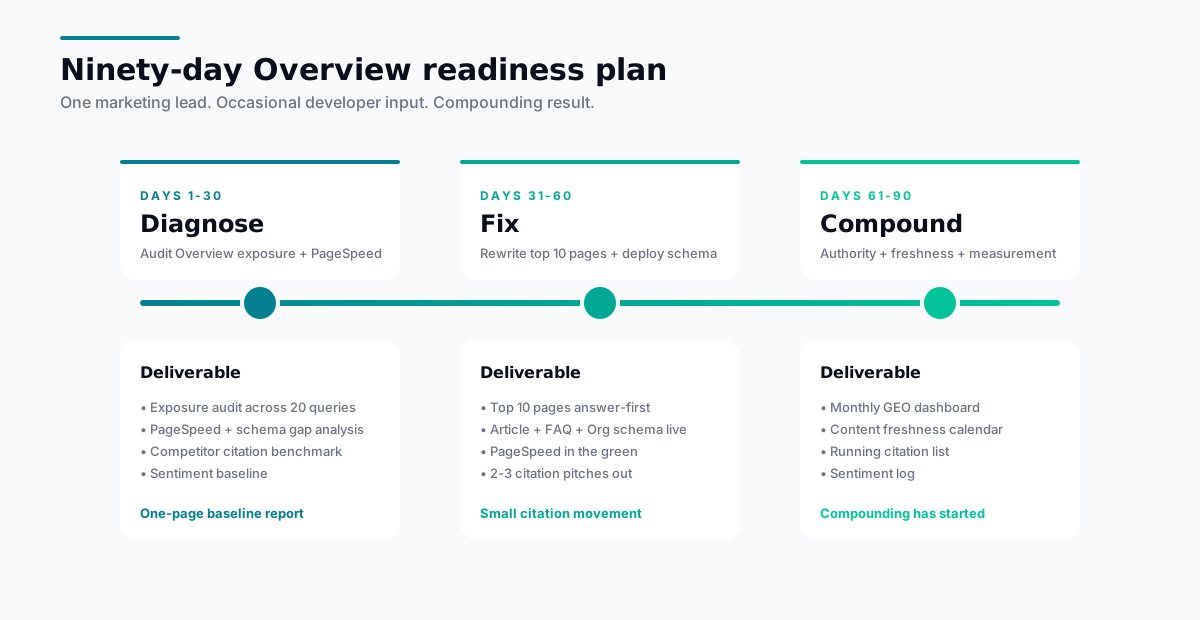
A practical checklist for the next 90 days
Start with an audit of your current Overview exposure. Search your top 20 target queries in Google (signed out, Australian location) and note which ones show an Overview, which sources are being cited, and whether your brand appears. Use our free GEO Readiness Checker to get a baseline score on the technical and structural factors that drive citation.
Next, rewrite your top 10 highest-traffic pages in answer-first format. Put a two-sentence direct answer at the top of every page. Rewrite H2 headings as questions. Add or refresh FAQ schema. Check that your Article schema includes author, publish date and modification date. Make sure Organization schema identifies your business cleanly.
Then work on authority and freshness. Refresh cornerstone content every 7 to 14 days. Earn citations on trusted Australian industry publications. Build topical clusters around the themes you want Google and the AI engines to associate with your brand. Finally, set up measurement in GA4 so you can track referrals from Google, ChatGPT, Perplexity and the other major sources independently and benchmark your share of voice over time.
How AI Overviews interact with Google Ads
One of the questions we get most often from Australian marketers is whether Google Ads placements are affected by AI Overviews. The short answer is yes, but not as dramatically as organic. Ads still appear above AI Overviews on most commercial queries, which protects the top ad slot. Where Ads lose ground is on the informational and research queries where users now get a complete answer from the Overview and never scroll. For advertisers, the practical response is to shift more paid investment toward lower-funnel keywords where intent is clear and the Overview is less likely to appear, while building the organic content layer that earns Overview citations on upper-funnel queries.
The integrated approach matters here. Treating SEO and Ads as separate budgets in 2026 misses the fact that the Overview has changed where each channel performs best. Our own clients have seen the best results from rebalancing spend as Overviews expand: less paid investment on informational queries, more on transactional, and a larger organic content programme feeding the Overview citations upstream.
How Australian businesses compare to global benchmarks
Australia sits slightly behind the US and UK in Overview exposure but is catching up fast. US advertisers have been dealing with Overviews on the majority of informational queries since mid-2024. UK rollout followed in late 2024. Australia's rollout accelerated through 2025 and is now at roughly the same level as the UK was six months ago. The implication is that the patterns we have seen in the US over the last 18 months (traffic redistribution, CTR compression on informational queries, growing emphasis on content citation over ranking) are the patterns Australian businesses should expect to see through 2026.
What is different about Australia is the smaller total search market, which means citation share is easier to win for businesses that act early. In the US, a single informational query might have 20 competing sources in the Overview pool. In Australia, the equivalent query often has 3 to 6. Early movers in the Australian market are locking in citation share that will be much more expensive to win later, both in organic effort and in any eventual paid placement inside Overviews.
Frequently asked questions
Can you block AI Overviews from using your content?
Yes. Google offers a meta tag (nosnippet or max-snippet:0) that prevents your content from being summarised in an Overview. The trade-off is that you lose the citation and the link alongside it. In almost every case, losing the citation is worse than being summarised, so we recommend against blocking.
Do AI Overviews affect local SEO?
Less so for transactional local queries (where the Local Pack still dominates), more so for informational local queries like "how to choose an accountant in Sydney". Local businesses should continue investing in Google Business Profile for the Local Pack while building an informational content layer that targets Overview citations on upstream research queries.
How long does it take to start earning Overview citations?
Citation exposure moves faster than classic ranking. Businesses that rewrite their top ten pages in answer-first format and improve schema typically see Overview citation appearances within four to eight weeks, assuming the underlying pages already rank in the top 20 organic results. Brand new pages on low-authority domains take longer because authority is the hardest of the three factors to build quickly.
Does Overview traffic convert as well as traditional organic?
In ClickedOn client data, AI-referred visitors (including Overview click-throughs) convert at 4.4 times the rate of traditional organic visitors. The buyer arriving from an Overview has already read a synthesised answer and clicked through because they wanted more. That intent shift explains the conversion lift, and it is why Overview citation share is worth more than raw traffic volume suggests.
Can I optimise for Overviews without overhauling my whole SEO programme?
To a point. Adding answer-first intros, FAQ schema and refreshed content to your top ten pages will move the needle without a full replatform. Deeper work (site speed remediation, schema coverage across the site, topical cluster content) sits inside a broader SEO programme. If your core pages do not yet rank in the top 20 organic results, classic SEO fundamentals are still the prerequisite.
How do I know which of my queries show Overviews?
Run your top twenty target queries manually in Google, signed out, with an Australian location. Log which ones show an Overview, which sources are cited, and whether your brand appears. Purpose-built platforms automate this, and our AI Visibility Audit gives you a snapshot across Overviews and the other major AI engines in under a minute.
Key takeaways
- Google AI Overviews now appear on roughly 25% of Australian search results, up from 13% a year earlier. When they appear, CTR on classic organic drops by up to 58%.
- Three factors drive Overview citation: traditional organic ranking (76% of cited URLs are already in the top ten), answer-first content structure, and topical authority plus freshness.
- Australia is six months behind the US in Overview exposure. That timing is the opportunity: fewer competitors in the citation pool, lower cost to earn a share.
- SEO and Overview optimisation are now tightly linked but no longer identical. Rankings alone are not enough. You also need answer-first structure, clean schema, and refreshed cornerstone content.
- Ads still mostly appear above Overviews on transactional queries. Rebalance paid spend toward lower-funnel keywords and invest organic effort in the informational content layer that feeds Overview citations upstream.
- Local businesses should keep investing in Google Business Profile for the Local Pack, and add an informational content layer for upstream research queries.
Where to start
If you have ten minutes, search your top twenty target queries in Google (signed out, Australian location) and log which show an Overview, which sources are cited, and whether your brand appears. That is your baseline. If you have a week, rewrite your top ten pages in answer-first format and deploy FAQ schema using our free schema generator.
Our free GEO Readiness Checker scores your domain against the technical and structural factors that drive Overview citation in under a minute. Google AI Overviews are not going away, and the Australian rollout is only accelerating. Businesses that act in 2026 will own the citations that matter for the next five years. Have a look at what we do or send us a note if you want the full programme run for you.