
Why AI assistants recommend some brands and ignore others comes down to whether a model can verify what you claim. ChatGPT, Perplexity, Gemini, Copilot and Google AI Overviews assemble every answer from sources they can retrieve, check against each other and read quickly, then name two or three brands. The ones that get named usually have independent corroboration, an answer in their opening lines, and pages a machine can parse without guessing. There is no formula, and no agency can promise you a citation. What you can do is close the gap between what your brand is and how legible that is to a model.
Your CEO read something about AI search and wants a plan by Friday. The awkward part is that most of what decides whether an assistant names your brand happens somewhere other than your website. That shifts who owns the work, what you measure, and how you report it upstairs.
What decides whether an assistant names your brand
AI assistants recommend brands they can verify. A model retrieves a small set of sources, checks whether those sources agree, and prefers content that states its answer plainly and carries recent, structured detail. Brands with thin presence off their own domain get skipped, even when their website is excellent.
The five factors, roughly in the order we see them bite:
- Corroboration. Independent sources saying the same thing about you: industry media, review platforms, directories, an author with credentials a reader can check.
- Answer-first structure. The claim sits in the first 100 words, not the eighth paragraph.
- Presence beyond your domain. Reddit threads, comparison articles, podcast transcripts, supplier listings, association member pages.
- Machine legibility. Schema markup, clean HTML, and crawler access for the assistants you care about.
- Freshness. A visible review date, and content that reflects what is true now rather than two years ago.
What changes when a model curates instead of ranks
| Classic search signal | What the assistant uses instead |
|---|---|
| Backlinks | Agreement across independent sources |
| Meta description | The first 100 words of the page |
| Keyword density | One clear claim per section |
| Domain authority | Topical depth plus recency |
| Sitemaps and crawl budget | Schema markup and clean HTML |
Classic search still feeds the machine. Retrieval usually starts with an index, so ranking well improves your odds of being pulled into an answer. Anyone telling you SEO is finished is selling something.
What changed is the unit of competition. The prize is one sentence inside an answer that also names your competitors, and there is no position one to buy. Which means the reporting line your board already understands, rank and impressions and clicks, does not describe this surface at all.
Corroboration is the deciding factor
Take a hypothetical mid-market Australian software company wondering why Perplexity keeps naming two rivals and never them. Their homepage calls them the category leader. Nothing else on the internet repeats it. The rivals turn up in a comparison post, a software category listing, and a Whirlpool thread arguing about pricing. The model holds three independent sources for the rivals and one claim the company published about itself, so it names the rivals.
Trust signals behave the same way. Authors with real credentials, business details that match across every profile, and reviews on platforms you do not own all give a model something to check you against. Describing yourself gives it nothing. That makes AI visibility closer to reputation work than keyword work, and it usually sits with PR, partnerships and customer marketing rather than with your SEO agency alone. Read our explainer on GEO, AEO and LLMO if the terminology is still muddy internally.
Make your pages legible to a retrieval system
Four technical fixes do most of the work.
Add schema markup for your business entity, your products, your FAQs and your articles, then confirm each type renders properly (you can validate your structured data with the Schema Validator). Allow the crawlers you want, since GPTBot, PerplexityBot, ClaudeBot and Google's AI crawler controls all read your robots file. Rewrite the first 200 words of your top ten pages so the answer arrives before the context. Put a review date on anything carrying a factual claim.
On llms.txt, our position is mild. Adoption across the assistants is uneven, the file takes about 20 minutes to write, and it will not rescue a site with blocked crawlers or no corroboration from anyone else. Add it, then go and do the four fixes above. Do those before you commission another content series.

How to audit AI visibility and report it to your board
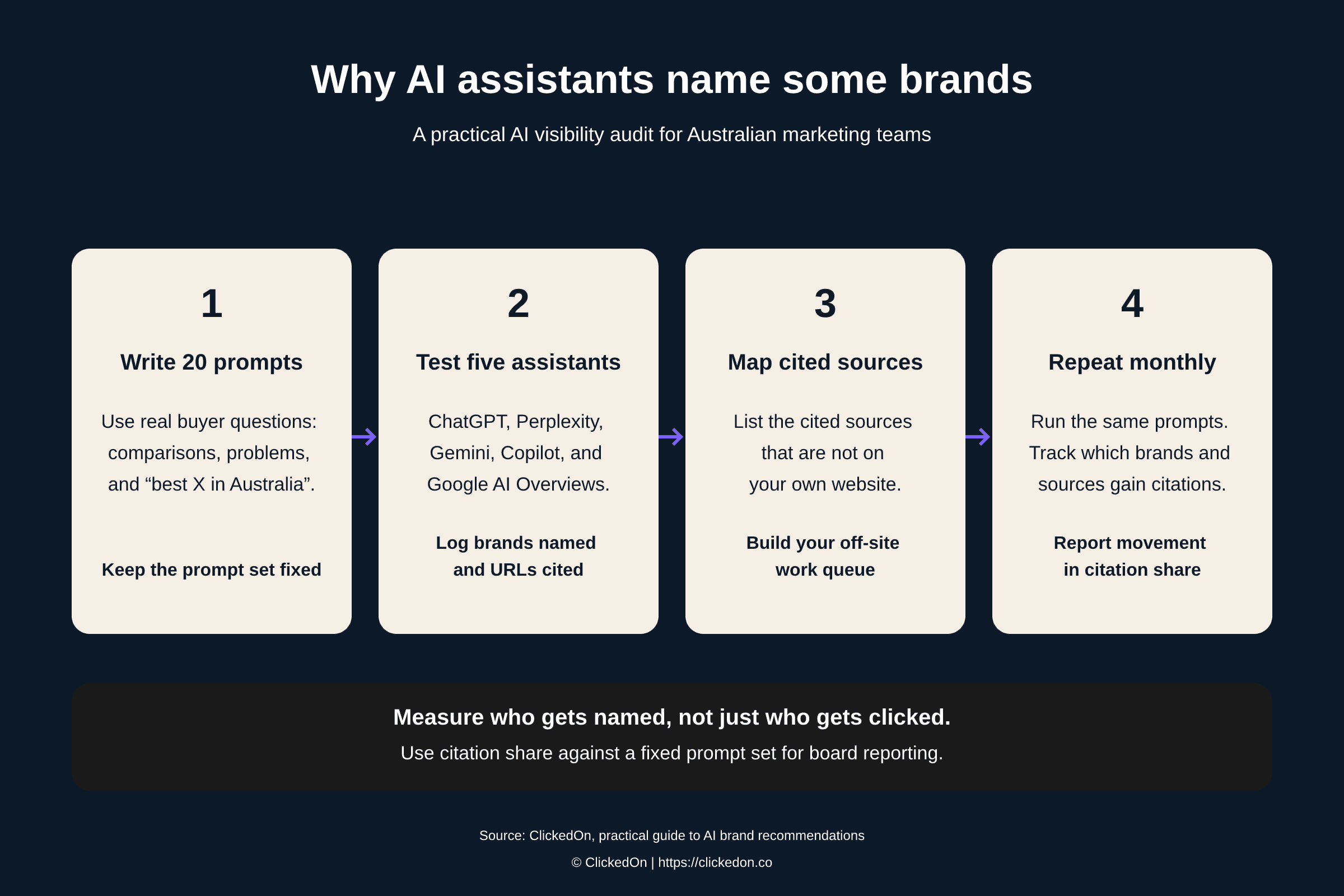
Manual prompt testing is the fastest audit and it costs an afternoon. Write the prompts your buyers actually type, run each one across ChatGPT, Perplexity, Gemini, Copilot and Google AI Overviews, and log which brand gets named and which URL earned the citation. A tracking tool automates the same check daily.
- Write 20 prompts a real buyer would use. Mix comparison prompts, problem-led prompts, and "best X in Australia" prompts.
- Run every prompt across the five assistants. Log whether you appear and which URL earned the citation.
- List the cited sources that are not yours. That list becomes your off-site work queue for the quarter.
- Repeat monthly against the same prompt set. Answers move, and the movement is the metric.
For the board, report citation share against a fixed prompt set rather than "AI traffic". Segment AI-referred sessions in GA4 by referrer so the number is at least directionally real, and name the part you cannot attribute yet. Our published insight on GEO terminology reported a 527% year-on-year rise in AI-referred sessions, which is the kind of trend line your CEO has probably already read somewhere. Give them the movement on your own prompt set instead. If you want the tracking automated, the ClickedOn app checks visibility daily across those five assistants from A$99 a month.
Key takeaways
- AI assistants curate rather than rank. Verification decides who gets named.
- Most of the work sits off your website, across reviews, forums, directories and industry media.
- Put the answer in the first 100 words of every page that matters.
- Schema, crawler access and review dates are the cheap fixes. Do them first.
- Measure citation share on a fixed prompt set monthly, and report the movement rather than the raw traffic.
Find out what the assistants say about your brand
Run a free AI Visibility Audit and see which prompts name you, which name your competitors, and which URLs are earning the citations. If you would rather start with a technical score, the GEO Readiness Checker takes a few minutes, and ClickedOn's GEO and LLMO services cover the work that follows. We are a Sydney Google Premier Partner, five consecutive years running, top 3% globally, with $12m+ in ad spend managed for brands that went on to $1.2b+ in combined exits.