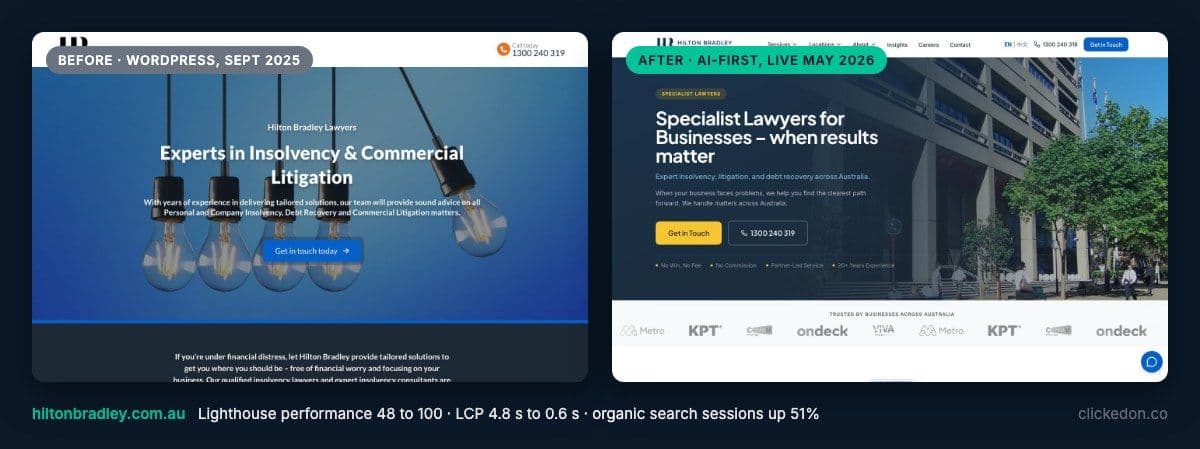
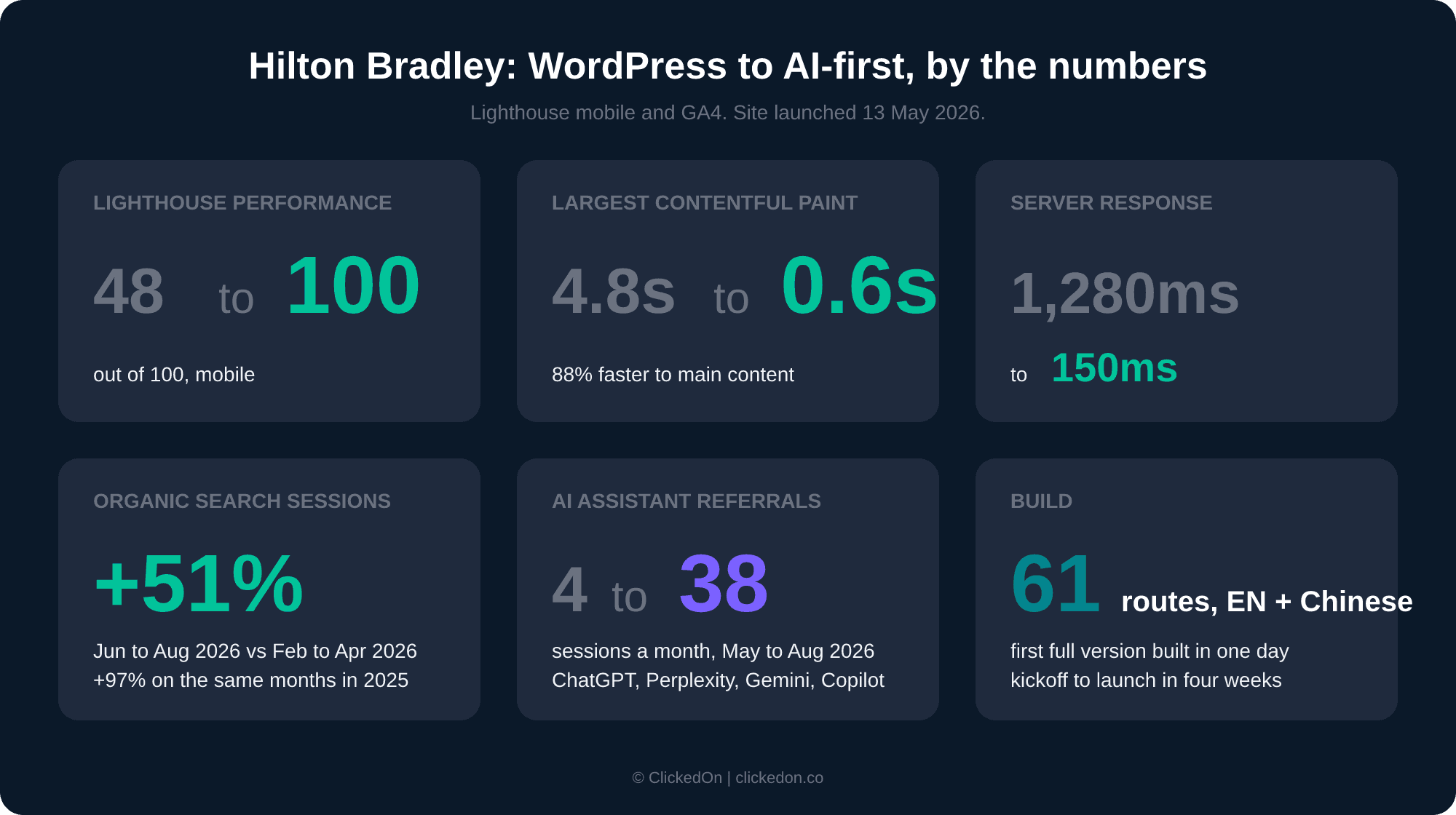
To upgrade a WordPress website to an AI-first website, you rebuild the front end on a modern framework, carry every URL and piece of content across with mapped redirects, then add an AI layer that does real work: a concierge that answers from the business's own knowledge, tools that give visitors a useful result, and structured data that AI search engines can read. We did exactly this for Hilton Bradley Lawyers in 2026. Lighthouse performance went from 48 to 100, Largest Contentful Paint fell from 4.8 seconds to 0.6 seconds, and organic search sessions in the three months after launch were 51% higher than in the three months before (GA4, February to April against June to August 2026). This guide sets out the seven steps we use, what to keep from WordPress, and what to measure once the new site is live.
What is an AI-first website?
An AI-first website does useful work for the visitor, and every page on it is as easy for a machine to read as for a person. Three things define how it works.
- It acts. A concierge answers questions from the firm's own services, locations and FAQs, not from a generic model. Tools take a visitor's inputs and return an assessment. Forms verify an ABN while the visitor types, capture where the enquiry came from, and land the lead in a CRM with the right people notified.
- It is legible to AI search. Clean HTML, JSON-LD schema on every page type, a sitemap, an llms.txt file, and a direct answer in the first 100 words of each page. ChatGPT, Perplexity, Gemini and Google AI Overviews retrieve pages before they cite them, and heavy templated markup gets in their way. Our guide on how to get cited in ChatGPT covers the content side.
- It is fast and stays editable. Pages are generated ahead of time and served from a global edge network, so the page is ready before the visitor asks for it. Content changes can be proposed by AI and approved by a person, without a developer in the loop.
"Agentic" describes what the site does beyond the chat window. Qualifying a debt-recovery enquiry at 2 am, checking the debtor's ABN and emailing the right partner is a practical example.
Why move off WordPress now?
WordPress runs more websites than any other content management system, and for a content-heavy site with a competent maintainer it still works. There are a few practical reasons to move.
- Weight. Page builders, plugins and themes each add their own scripts and styles. Hilton Bradley's old home page took 4.8 seconds to show its main content on mobile, and the server took 1.28 seconds to respond at all. Google's Core Web Vitals thresholds call for 2.5 seconds and 0.8 seconds respectively.
- Maintenance risk. Every plugin is a dependency someone has to patch. Most small-business sites have a dozen or more, and nobody owns the job.
- Machine readers. AI assistants and answer engines read pages the way a hurried researcher does. They favour a clear answer near the top, headings that name the question, and structured data that confirms who you are. Templated WordPress markup rarely gives them that.
- Control. When performance, schema and redirects live in code you own, you can set budgets and test them on every deploy. With a theme and a stack of plugins, you inherit whatever they ship.
Hilton Bradley's mobile Lighthouse scores before the rebuild were 48 for performance, 54 for SEO and 52 for accessibility. Those numbers are typical for a WordPress site that has had five years of additions.
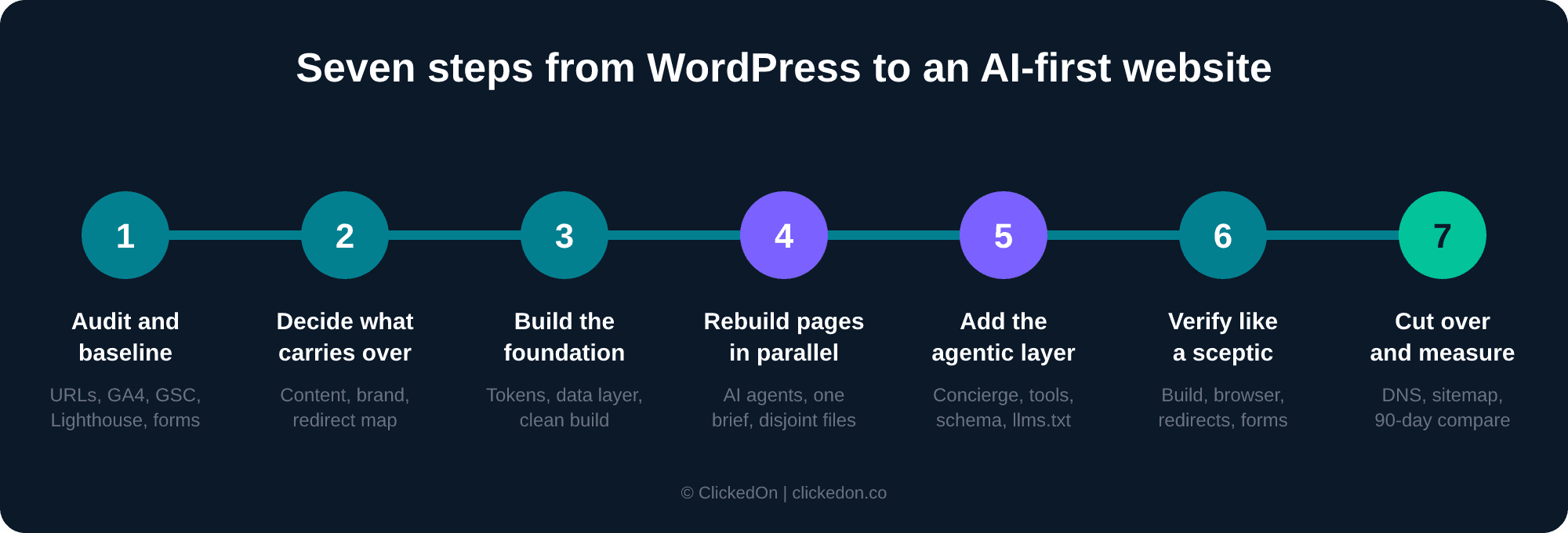
The seven steps to upgrade a WordPress website to an AI-first website
1. Audit and record the baseline
Crawl every URL on the current site and export the list. Pull 16 months of Google Search Console data and GA4 sessions by channel. Run Lighthouse on each page template, not just the home page. List every form, tracking tag, email flow and third-party integration. Write the numbers down as the "before" state. Without a baseline you cannot prove the upgrade paid for itself, and you cannot spot a redirect that quietly dropped a ranking page. Our technical SEO checklist covers what to record.
2. Decide what carries over
Most of the content should. The brand must, and it must come from the real site: sample the actual colours, fonts and logo rather than approximating them. Use the business's own photography. Days before the Hilton Bradley launch we removed stock images that turned out to be unlicensed and replaced them with the firm's own office photos. Build a redirect map that sends every old URL to its new home with a permanent 301, including language variants. Hilton Bradley needed more than 24 redirects, including its Chinese-language pages. Google's guidance on site moves with URL changes is the reference to work from.
3. Build the foundation, then prove it builds
We build on Next.js with TypeScript and Tailwind, deployed to Vercel. The foundation is the shared layout, brand tokens, fonts, the data layer for services, team and locations, and the knowledge base the concierge will read. Nothing else starts until a full production build passes cleanly. A broken base multiplies every problem the page work introduces later. We seed each new build from the last site we shipped, so every foundation carries the lessons of the previous one.
4. Rebuild the pages in parallel
This is where AI changes the economics of a website project. With a written build brief, we run several Claude coding agents at once. Each owns a disjoint set of files: one takes the service pages, one the team, one the location pages, one the insights section. None of them edits the shared foundation. For Hilton Bradley, the first complete version of the site, 61 routes in English and Chinese, was built in a single working day.
That first draft still needed work before launch. Client review, legal-currency checks on the content, photography and launch preparation took the rest of the four weeks. The difference is that the client reviewed a working site on day one rather than a wireframe in week three. We wrote about the same approach in how we built Geo with Claude Code.
5. Add the agentic layer
On Hilton Bradley's site, this layer has four parts.
- A concierge that knows the firm. Claude answers questions from a knowledge base written from the firm's services, locations, fee model and FAQs. It declines questions outside that scope, falls back to a plain message if the model is unavailable, and is rate-limited per visitor.
- A tool that does a job. The debt recovery assessment takes the debt amount, debtor type, whether it is disputed, its age, the documentation held, the state and whether a letter of demand has gone out. It returns the likely pathway, for example a statutory demand for an undisputed company debt above $4,000, with indicative timeframes and a cost explanation. A rules-based version answers if the model does not.
- Forms that qualify and route. The enquiry form looks up the ABN or ACN against the Australian Business Register while the visitor types. Spam is filtered by Cloudflare Turnstile, a honeypot field and timing checks. Source, medium, campaign, keyword and click IDs are stored with the lead. The lead lands in the CRM, and branded confirmations go to the client and the partners on duty.
- Machine readability. JSON-LD for LocalBusiness, Service, FAQPage, Article and BreadcrumbList on the relevant templates, a generated sitemap, robots rules and an llms.txt file that describes the firm to AI crawlers. Run the output through our free schema validator before launch.
6. Verify like a sceptic
A passing type-check is not a working site. Run the full production build and lint, because they catch server and client boundary errors a type-check misses. Open every page in a real browser and look at it. Run Lighthouse on each template and hold the line at 95 or better on mobile. Test every redirect in the map. Submit every form, including the failure paths. Check keyboard navigation, the skip link and ARIA labels. Ask the concierge questions it should refuse, and confirm it refuses them.
7. Cut over and measure
Change only the website DNS records. Leave MX, SPF, DKIM and DMARC alone, and put transactional email on a subdomain so the firm's main domain reputation is untouched. Keep the old host live for 30 days as a fallback. Submit the sitemap, watch Search Console for crawl errors over the first 48 hours, and move conversion triggers in Google Tag Manager to the new thank-you paths. Then leave it alone and compare 90 days of data against the baseline you recorded in step one.
What happened at Hilton Bradley
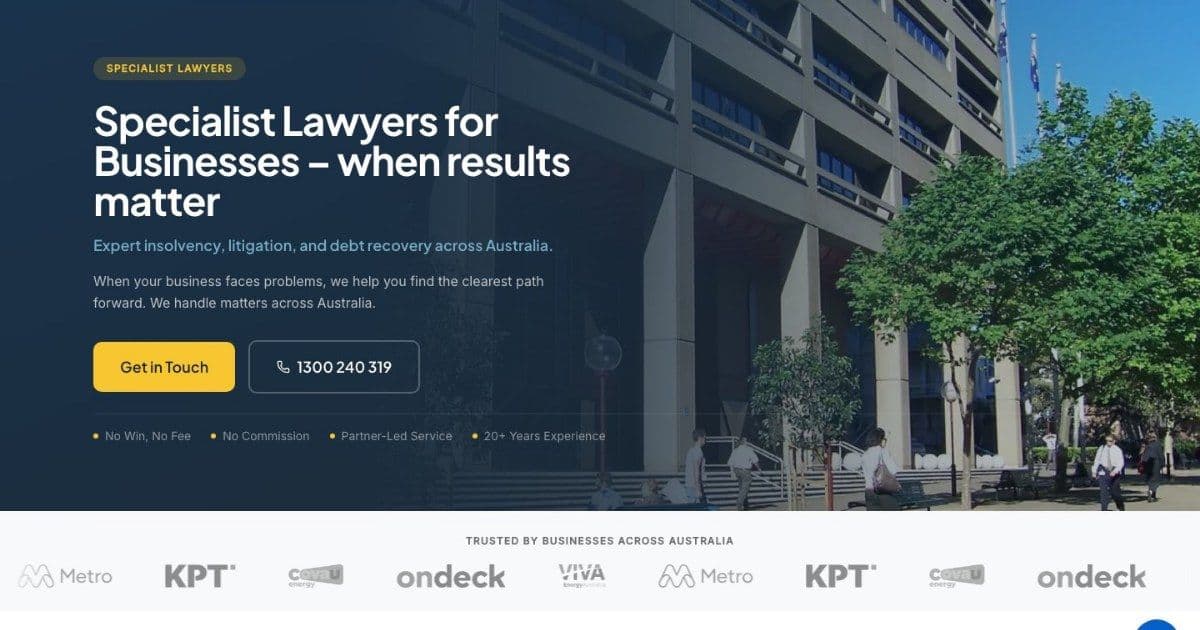
Hilton Bradley Lawyers is a specialist insolvency, litigation and debt recovery firm with offices in Sydney, Melbourne and Brisbane. Its WordPress site went live in its new form on 13 May 2026. The numbers below come from Lighthouse and GA4, both of which our Geo platform reads directly.
| Measure | Before (WordPress) | After (AI-first) |
|---|---|---|
| Lighthouse performance, mobile | 48 | 100 |
| Lighthouse SEO | 54 | 100 |
| Lighthouse accessibility | 52 | 93 |
| Largest Contentful Paint | 4.8 s | 0.6 s |
| Speed Index | 6.6 s | 1.0 s |
| Server response time | 1,280 ms | 150 ms |
| Organic search sessions, three months | 1,611 (Feb to Apr 2026) | 2,439 (Jun to Aug 2026), up 51% |
| Organic search sessions, same months a year earlier | 1,237 (Jun to Aug 2025) | 2,439, up 97% |
| Sessions referred by AI assistants | 4 (May 2026) | 38 (Aug 2026) |
Two details matter when reading that table. Paid search on the account was paused on 3 July, so the organic lift is not spill-over from ads. Direct traffic stayed inside its normal range throughout, which rules out a branding campaign as the cause.
How speed, quality and design fit together
Building quickly while maintaining quality takes a repeatable process, with the same checks on every project.
- Speed to market. Four weeks from kickoff to launch, with a complete working version on the first day. The time saved is spent on review, not on waiting for a developer to wire up a page.
- Quality. Every build passes the full production build, lint, a browser walk-through and Lighthouse before it is shown to anyone. The test we apply is simple: would this embarrass a client with sophisticated taste? If yes, it does not ship.
- Design. The brand is sampled from the real site, then improved. Hilton Bradley's rebuild kept its navy, brought the firm's yellow accent through every call to action, added a bilingual header with 中文 alongside English, put the firm's own office photography in the heroes, and kept the hero proportions of the old site so returning visitors would recognise it. The aim was to improve the design while keeping the firm's identity.
Removing unlicensed stock imagery days before launch cost a day, but avoided the risk of using it.
What stays editable after launch
A site that only a developer can change is a liability, however fast it is. The sites we ship are built so the client's team can edit content without one: AI proposes changes, a person approves them, and the site republishes. Every month the site's traffic, rankings and AI visibility roll into the same reporting the firm gets for its marketing, so the "after" numbers keep being measured against the baseline. If AI search matters to your business, our GEO service tracks which prompts name you and which name a competitor.
Frequently asked questions
Will we lose our Google rankings when we leave WordPress?
Not if every old URL is mapped to its new home with a 301 redirect and the content that ranked is carried across. Rankings are attached to URLs and content, not to the CMS behind them. The risk comes from unmapped pages and changed headings, which is why the audit in step one lists every URL and its search value before anything is rebuilt. Hilton Bradley's organic sessions rose 51% in the three months after launch.
Can we keep our WordPress blog posts?
Yes. Posts export cleanly and are imported into the new site's content layer with their original URLs, dates and authors preserved. Hilton Bradley's insights section carries its earlier articles and has published new ones since launch, each with Article schema and author attribution.
How long does an upgrade take?
Four weeks from kickoff to launch is our standard for a site of Hilton Bradley's size, around 60 routes across two languages. The first full working version exists within days. Most of the remaining time is client review and content checks, which are the parts worth spending time on.
What does it cost?
A standard website upgrade starts from $10,000 plus GST with a fixed quote before we start. Complex builds with custom tools, several languages or many integrations run up to $20,000 plus GST. Hosting and the AI concierge run on usage-based infrastructure the client owns, so there is no platform lock-in.
Is an AI chat on a professional services site a risk?
It is if it is generic. The concierge on Hilton Bradley's site answers only from the firm's own knowledge base, declines anything outside it, carries a general-information disclaimer, and is rate-limited. The debt recovery tool has a rules-based fallback, so the visitor gets a sound answer even if the model is unavailable.
What is llms.txt and do we need one?
An llms.txt file is a plain-text summary of your business and pages, placed at the root of your site for AI crawlers to read. It is cheap to add and takes minutes to maintain. It does not replace schema, clean HTML and answer-first content, which do most of the work.
Do we have to use Next.js and Vercel?
No. That is our stack, chosen for static generation, edge delivery and a build pipeline our AI agents work well in. The seven steps apply to any modern framework. What does not change is the requirement to own the code, the domain and the content.
Key takeaways
- Baseline first. Record URLs, Lighthouse scores, GA4 and Search Console before you touch anything, or you cannot prove the result.
- Redirect everything. Rankings follow URLs and content, not the CMS. Hilton Bradley kept its rankings and grew organic sessions 51%.
- Build the foundation alone, the pages in parallel. AI agents make a 61-route bilingual first version possible in a day, once the base builds clean.
- The agentic layer is the product. A concierge that knows the business, a tool that does a job, forms that qualify and route, and schema that AI search can read.
- Verify in a real browser. A passing type-check is not a working website. Lighthouse 95 or better on mobile is the bar.
- Own the stack. Domain, code, content and data stay with the client. No platform lock-in.
Get your free website audit
If your WordPress site is more than three years old, we will run the step-one audit for you at no cost: Lighthouse on every template, redirect risks, and how AI assistants currently describe your business.
Get your free website audit or read the Hilton Bradley case study.