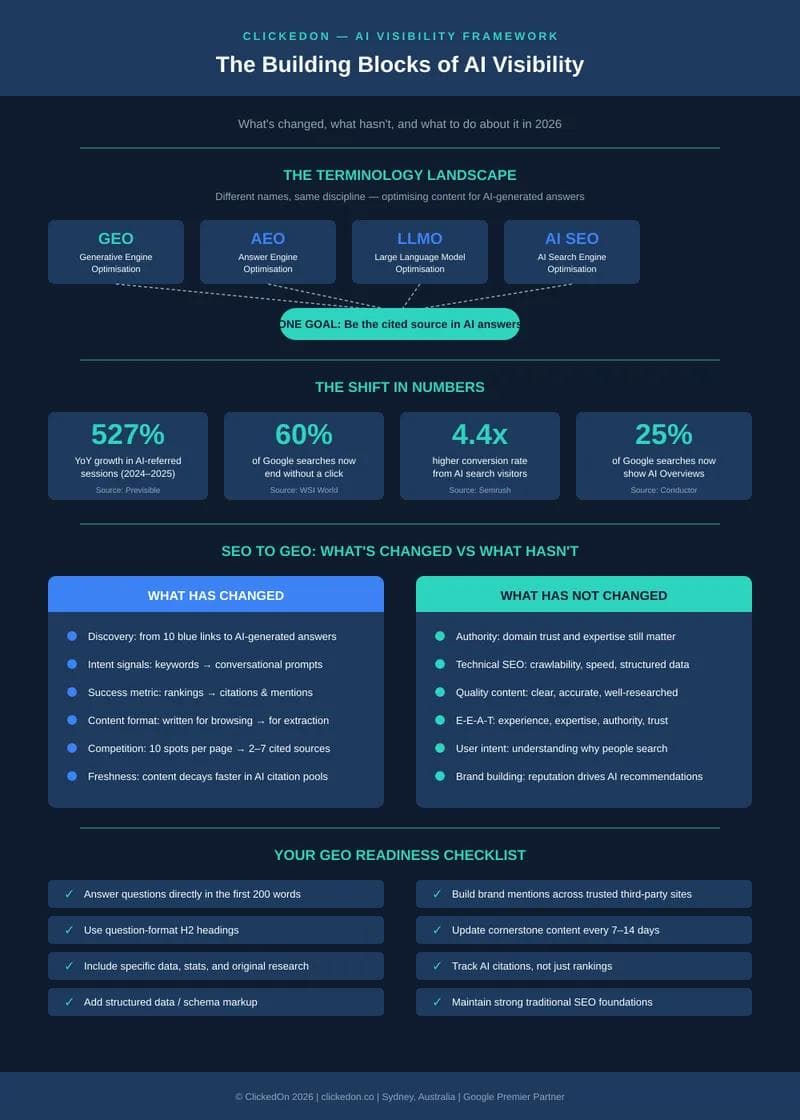
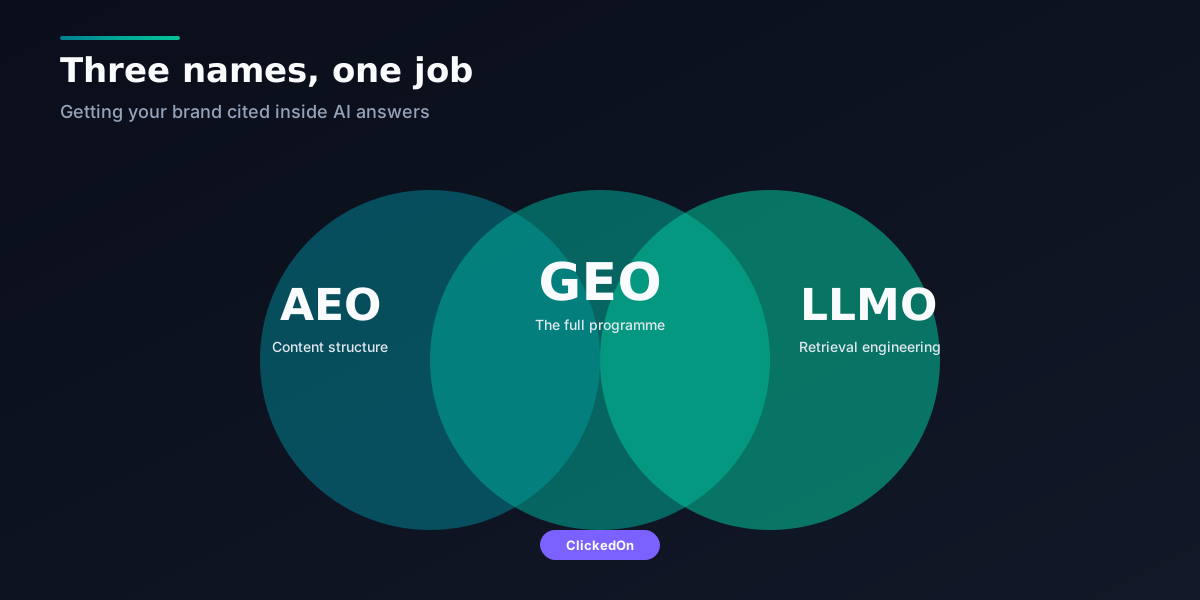
AEO, GEO and LLMO are three names for the same underlying job: getting your brand cited inside AI-generated answers. AEO (Answer Engine Optimisation) is the oldest of the three, originally coined for voice assistants and now used to describe content engineered to earn direct answers inside AI chat interfaces. GEO (Generative Engine Optimisation) is the broadest term, introduced in 2023 by researchers at Princeton and IIT Delhi, and is now the most widely adopted label across the industry. LLMO (Large Language Model Optimisation) is the most technically precise of the three, focusing specifically on how content is retrieved, ranked and cited by large language models like GPT-4, Claude and Gemini.
In practice, the three disciplines overlap heavily. The tactics that earn an AEO answer usually earn a GEO citation, and both feed into LLMO performance. If you want the short version: pick whichever term your team prefers, but make sure the work is happening. In 2026, what matters is that your business is being cited when a prospective customer asks ChatGPT, Google AI Overviews, Perplexity or Claude a question that should lead to you. For a deeper tour of the full category, our guide to what GEO is and why it matters walks through the research base and the case for investment.
What is AEO?
AEO stands for Answer Engine Optimisation. The term predates the current generative AI wave by almost a decade. It was originally used to describe the work of structuring content so that voice assistants like Siri, Alexa and Google Assistant could read out a direct answer to a spoken question. Featured snippets, FAQ schema, and the "People Also Ask" box were the main surfaces AEO was built around.
In 2026, AEO has been quietly absorbed into the generative search conversation. The core principle is the same: write content that is directly extractable as an answer. What has changed is the destination. Instead of optimising for Google's answer box, AEO now targets the answer panes inside ChatGPT, Perplexity, Google AI Mode and Claude. The tactics that worked for voice search (concise definitions, question-format headings, plain language, structured data) are the same tactics that work inside LLM answers. Our dedicated answer engine optimisation service treats AEO as the content-structure layer of a wider GEO programme.
What is GEO?
GEO stands for Generative Engine Optimisation. The term was coined in a 2023 paper from Princeton University and IIT Delhi that proposed a formal framework for measuring and improving content visibility inside generative search engines. GEO is the umbrella label covering everything you do to earn citations, mentions and recommendations from AI-powered answer engines, whether that is ChatGPT, Google AI Overviews, Perplexity, Claude, Gemini or Microsoft Copilot.
GEO includes AEO as a subset. It also includes brand citation building, schema markup, technical accessibility for AI crawlers, and content freshness. Because GEO is the broadest of the three terms, it has the most industry traction. The GEO Conference series, most of the published academic research, and most of the tooling in the market now use this label. At ClickedOn, we use GEO as our primary term because it captures the full scope of the work, not just content structure. Our core GEO service covers the full programme: audit, answer-first content, citation building, schema, and measurement across every major AI engine.
What is LLMO?
LLMO stands for Large Language Model Optimisation. It is the most technically precise of the three terms and the one most often used by engineers and researchers. LLMO focuses specifically on how content is retrieved and ranked inside a large language model's context window, including the retrieval-augmented generation (RAG) pipelines that platforms like ChatGPT and Perplexity use to fetch live sources.
LLMO overlaps with GEO but is slightly narrower. Where GEO includes surface-level discovery features like Google AI Overviews (which are a hybrid of classic search ranking and generative summarisation), LLMO concentrates on the pure LLM use case: a user asking Claude or GPT-4 a question and the model deciding which sources to pull into its answer. If you are building an internal knowledge base, a customer-facing chatbot or a RAG application, LLMO is the vocabulary you will hear most often. Our LLM optimisation service focuses on that retrieval layer specifically.
AEO vs GEO vs LLMO: the practical differences
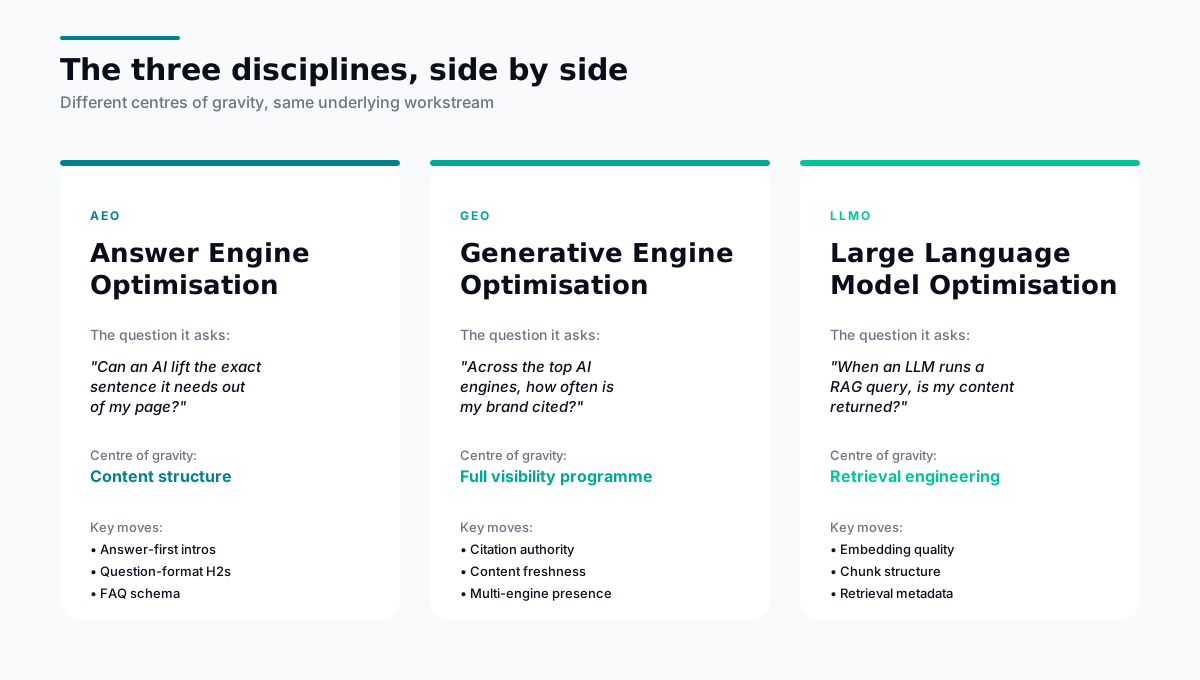
The three disciplines share more than they differ on, but each has a distinct centre of gravity. AEO is about content structure. The question it asks is: "Can an AI lift the exact sentence it needs out of my page without reformatting?" The answer depends on whether your H2 headings read as questions, whether the first 200 words answer the primary query directly, and whether your schema markup tells engines what the page is about.
GEO is about the full visibility programme. It asks: "Across the top AI engines, how often is my brand being cited, mentioned and recommended?" The answer depends on content structure, yes, but also on domain authority, third-party citations on trusted sites, content freshness, and whether you are present across ChatGPT, Perplexity, Google AI Overviews and Claude rather than just one of them. SE Ranking's analysis of 2.3 million pages found that high-domain-authority sites earn 3x more AI citations than lower-authority sites, which is why GEO is never a pure content exercise.
LLMO is about retrieval engineering. It asks: "When an LLM runs a RAG query, is my content being returned in the top results?" The answer depends on embedding quality, chunk structure, metadata, and whether the model's retrieval system can parse your page at all. LLMO is increasingly important for B2B brands whose buyers research inside Claude and ChatGPT before ever landing on a website.
Which term should you use in 2026?
If you are a marketer, use GEO. It is the broadest and most widely recognised term, and it is the one most of your peers and most of the tools on the market are using. If you are a content strategist focused specifically on extractable answers, AEO is still a useful label for that layer of work. If you are an engineer working on RAG pipelines or retrieval-focused tooling, LLMO is the precise term.
At ClickedOn, we treat all three as facets of the same programme. Our AI search optimisation service is the umbrella that covers AEO content structure, GEO citation building, and LLMO retrieval engineering under a single strategy. The reason is simple: trying to split them apart creates artificial boundaries that confuse teams and fragment budgets. AI engines do not care which term you use. They care whether your content is structured, cited, fresh and technically accessible.
What AI SEO really means
You will also hear the phrase "AI SEO" used as a catch-all for all of the above. It is not a formal term in the research literature and it is genuinely ambiguous: some people use it to mean AI-powered SEO tools (software that helps you do traditional SEO faster), while others use it to mean optimising for AI search engines. To avoid confusion, we recommend reserving "AI SEO" for the tooling conversation and using GEO, AEO or LLMO when you mean the optimisation discipline itself.
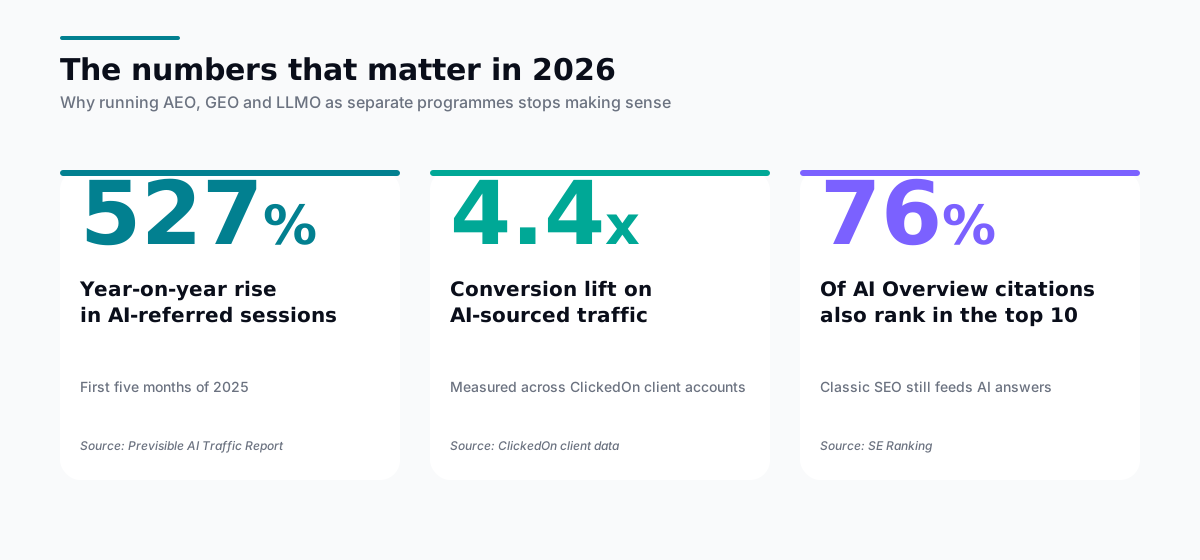
Traditional SEO is not dead in 2026. Around 76% of URLs cited in Google AI Overviews also rank in the top 10 organic results, according to SE Ranking. The foundations still matter. What has changed is the scoring: rankings alone are no longer sufficient. You need to be structured for extraction, authoritative enough to be cited, and present across every AI engine your buyers use.
How the three disciplines work together
In a healthy 2026 marketing programme, AEO, GEO and LLMO run as a single coordinated workstream. Content teams write answer-first pages with question-format headings (AEO). PR and brand teams earn citations on industry publications that AI engines trust (GEO). Technical teams make sure pages are crawlable, schema is clean, and retrieval systems can parse content (LLMO). Measurement teams track citations, brand mentions and AI-referred sessions across every major platform.
At ClickedOn we run this programme for clients across finance, health, retail and SaaS, and the results speak to why the integrated approach matters. In our client data, AI-referred visitors convert at 4.4 times the rate of traditional organic visitors. Previsible's AI Traffic Report tracked a 527% year-on-year rise in AI-referred sessions. Put those two numbers together and running AEO, GEO and LLMO as separate programmes stops making sense.
Getting started
If you are new to the category, start with an audit. Search for your brand in ChatGPT, Perplexity and Google AI Mode. Note which competitors are being cited and which are not. Then pick your top 10 highest-traffic pages and rewrite the first 200 words as direct answers to the primary query. Add question-format H2 headings. Make sure your schema markup is clean. That work alone, which is classic AEO, will move the needle inside AI answers faster than anything else.
Once the content layer is in place, the GEO work begins: earning citations on trusted industry publications, refreshing cornerstone content every 7 to 14 days, and expanding presence across every major AI engine. LLMO is the final layer for businesses whose buyers research deeply inside Claude and ChatGPT, or who are building their own RAG applications.
Common misconceptions about AEO, GEO and LLMO
The first misconception is that these disciplines replace traditional SEO. They do not. Classic SEO fundamentals (crawlability, site speed, backlinks, keyword research, on-page optimisation) remain the foundation. SE Ranking's analysis of 2.3 million pages showed that 76% of URLs cited in Google AI Overviews also rank in the top 10 organic results. You cannot shortcut the SEO work and expect AI citations to appear.
The second misconception is that AI traffic is too small to worry about. On an absolute volume basis it is still a fraction of classic organic, but on a conversion basis it is a different story. Previsible's AI Traffic Report tracked a 527% year-on-year rise in AI-referred sessions, and in ClickedOn client data AI-referred visitors convert at 4.4 times the rate of traditional organic visitors. Waiting until AI traffic is "big enough" means waiting until your competitors have already locked in the citations that matter.
The third misconception is that you need to pick one discipline and ignore the others. In practice, the tactics are so intertwined that treating them separately wastes effort. Our AI search optimisation service runs all three layers as a single workstream for exactly this reason.
How ClickedOn runs AEO, GEO and LLMO as one programme
At ClickedOn we have been running AI search optimisation as a managed programme since early 2025, making us one of the first Australian agencies to do so. The programme has four workstreams that run in parallel. The content workstream rewrites cornerstone pages in answer-first format with question-format headings (this is the AEO layer). The authority workstream earns citations on trusted Australian industry publications and builds unlinked brand mentions through PR, podcasts and community content (this is the GEO layer). The technical workstream covers schema markup, crawlability for AI bots, and retrieval metadata (this is the LLMO layer). The measurement workstream tracks citations, brand mentions and AI-referred sessions across ChatGPT, Perplexity, Google AI Overviews and Claude month by month.
The reason we run all four in parallel is that any single workstream on its own underperforms. A perfectly structured page with no authority does not get cited. High authority with badly structured content does not get extracted. Clean schema without freshness drops out of retrieval. Measurement without the other three is just dashboarding. The integrated programme is what moves the citation share needle consistently.
ClickedOn has been a Google Premier Partner for five consecutive years (top 3% of Google Partners in Australia), manages over $12m in annual ad spend, and has helped clients achieve over $1.2bn in trade sales. We founded the agency in 2014 and started the formal GEO programme in 2025.

Frequently asked questions
Is AEO the same as GEO?
Not quite. AEO is a subset of GEO. AEO focuses specifically on content structure (answer-first intros, question-format headings, FAQ schema) so that an AI engine can lift a direct answer out of your page. GEO is the broader programme that includes AEO plus citation building, domain authority, content freshness, and multi-engine presence. If you run AEO in isolation, you will write extractable content that never gets cited because the authority signal is missing.
Which term should I use with my leadership team?
Use GEO. It is the most widely recognised, has the strongest academic foundation (Princeton / IIT Delhi 2023), and covers the full programme rather than a single layer. Every tool on the market is now labelled GEO. "AI SEO" is recognisable but ambiguous, and LLMO is useful only with engineering or RAG teams.
Do AEO, GEO and LLMO replace traditional SEO?
No. SE Ranking's analysis of 2.3 million pages found that 76% of URLs cited in Google AI Overviews also rank in the top 10 organic results. Classic SEO fundamentals (crawlability, site speed, on-page optimisation, link building) remain the foundation. What has changed is that rankings alone are no longer sufficient. You also need answer-first structure, clean schema, third-party citations and content freshness for the AI layer to work.
How much does an integrated AEO / GEO / LLMO programme cost?
Cost depends on the content volume, the number of engines tracked, and the citation workstream scope. A useful benchmark: a programme that covers cornerstone content rewrite, schema deployment, monthly LLM tracking across five engines, and a managed citation workstream typically runs as a mid-four to low-five figure monthly retainer for Australian mid-market businesses. Have a chat with us if you want a tailored scope.
What can I do in the next 30 days to move the needle?
Three things, in order. First, rewrite your top ten pages with answer-first intros and question-format H2 headings. Second, deploy FAQ schema, Article schema and Organization schema across the same pages using our free schema generator. Third, run our free GEO Readiness Checker to get a baseline score, then pitch one expert byline to a trusted Australian industry publication in your category.
Key takeaways
- AEO, GEO and LLMO describe overlapping layers of the same programme. AEO is the content structure layer, GEO the full visibility programme and LLMO the retrieval engineering layer.
- GEO is the right term for most marketers. It is the broadest, the most recognised, and the one most tools and agencies now use.
- The tactics that earn an AEO answer usually earn a GEO citation and move LLMO retrieval at the same time. Treating them as separate programmes wastes effort.
- In ClickedOn client data, AI-referred visitors convert at 4.4 times the rate of traditional organic visitors. That is what makes the business case compelling even when absolute volumes are still small.
- Classic SEO is not dead. 76% of URLs cited inside Google AI Overviews also rank in the top ten organic results. You cannot shortcut the foundations.
- Early movers in Australia are locking in citation share that will be expensive to win back later. Waiting is the costly option.
Where to start
Whether you call it AEO, GEO or LLMO, the underlying work is the same and the time to start is now. If you want a baseline, our free GEO Readiness Checker scores your domain against the technical and structural factors that drive citation frequency in under a minute, no sign-up. It tells you the gaps. What you do next is your call.
If the scale of the content rewrite, the citation building or the tracking cadence is bigger than what you can run in-house, that is usually the right time to bring in a partner. We have been running AEO, GEO and LLMO as a single managed programme for Australian enterprise clients since early 2025. Have a look at what we do, or send us a note.