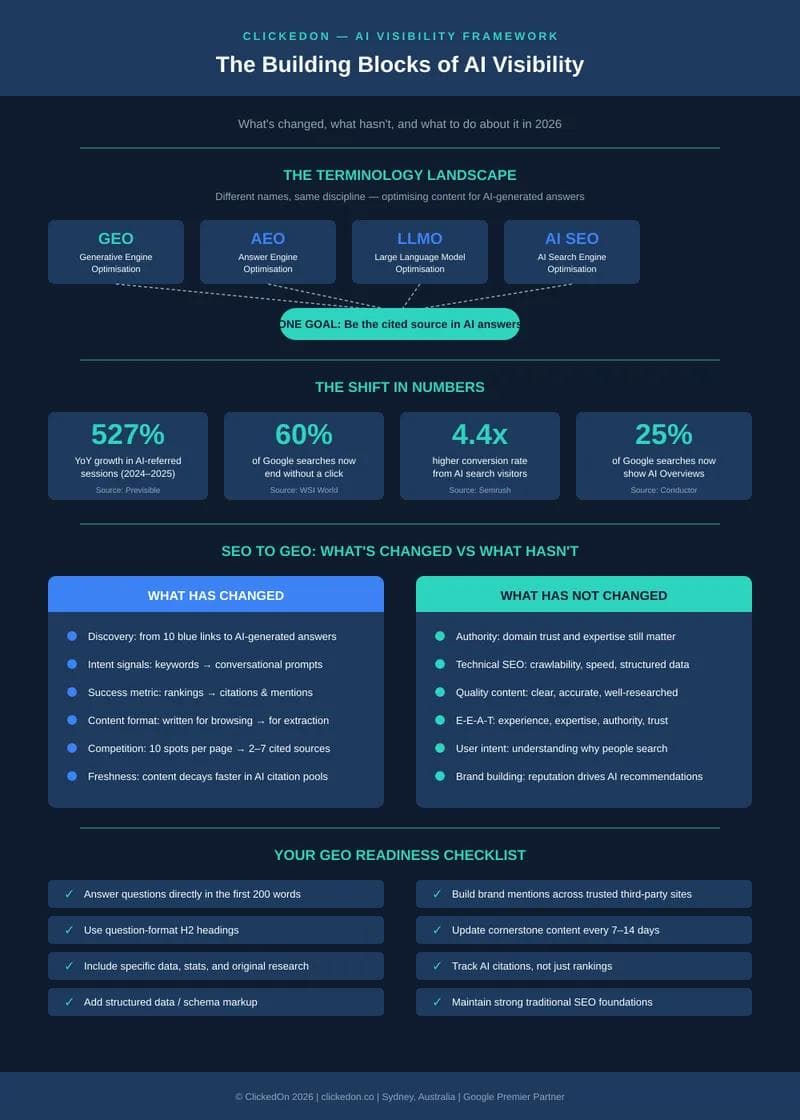
GEO (Generative Engine Optimisation) is how your brand earns citations, mentions and recommendations inside AI answers from ChatGPT, Google AI Overviews, Perplexity, Claude, Gemini and Copilot. AEO, LLMO and AI SEO describe narrower or more colloquial slices of the same work. In 2026, whatever term your team prefers, the job is the same: be present when a buyer asks an AI engine a question that should lead to you.
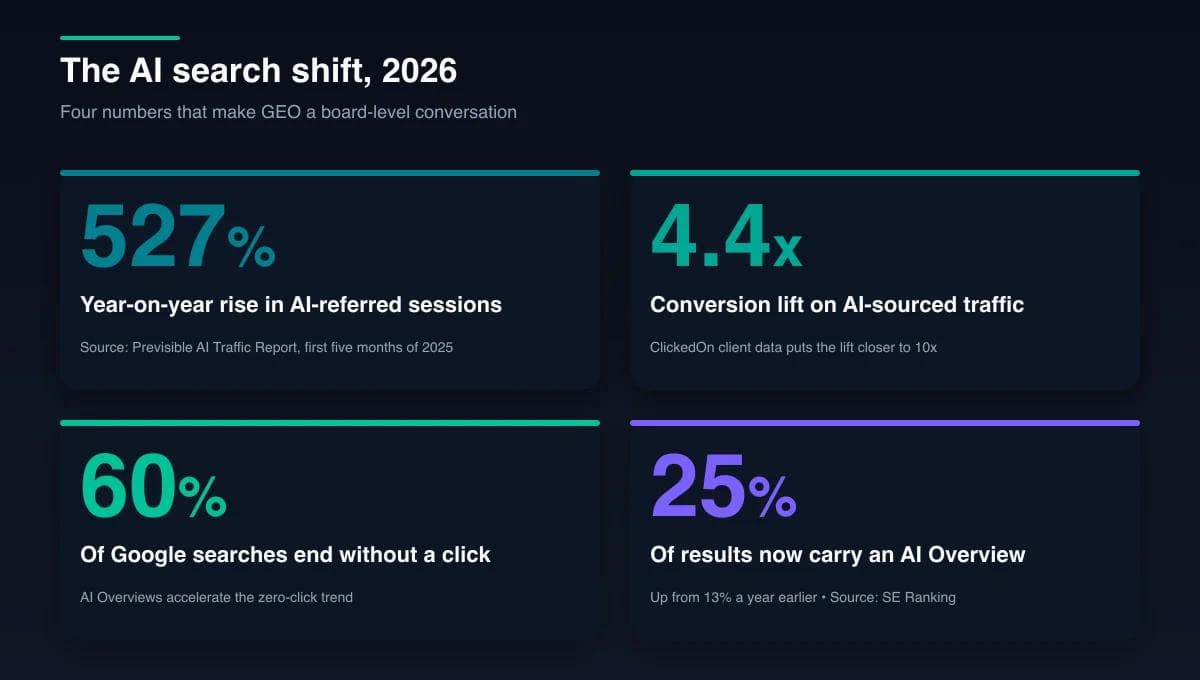
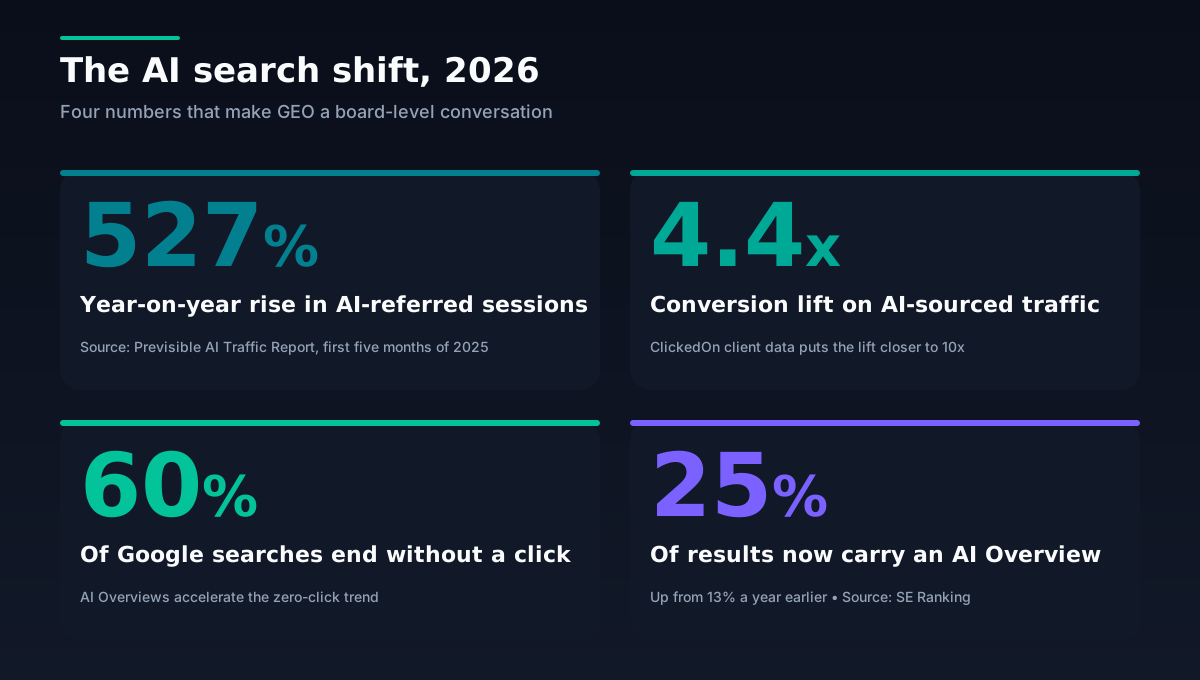
AI-referred website sessions surged 527% year-on-year in the first five months of 2025, according to the Previsible AI Traffic Report. ChatGPT alone now attracts 5.4 billion global monthly visits and processes around 2 billion queries every day. It has become the fifth most visited website on the planet.
At the same time, 60% of Google searches now end without a click. Google's AI Overviews appear in roughly 25% of search results, up from 13% just a year earlier. When those AI summaries appear, click-through rates to traditional organic results drop by up to 58%.
Gartner projects that traditional search engine volume will decline by 25% by the end of 2026. And here is the number that should get your attention: visitors arriving from AI-powered search convert at 4.4 times the rate of traditional organic visitors. In our data at ClickedOn, the conversion rate is 10x higher for AI traffic. When a user visits your site after doing all the background work on an LLM, they have already made their decision. The traffic is smaller, but it is dramatically more valuable, and being visible during the early LLM conversation is key.
What does GEO actually mean?
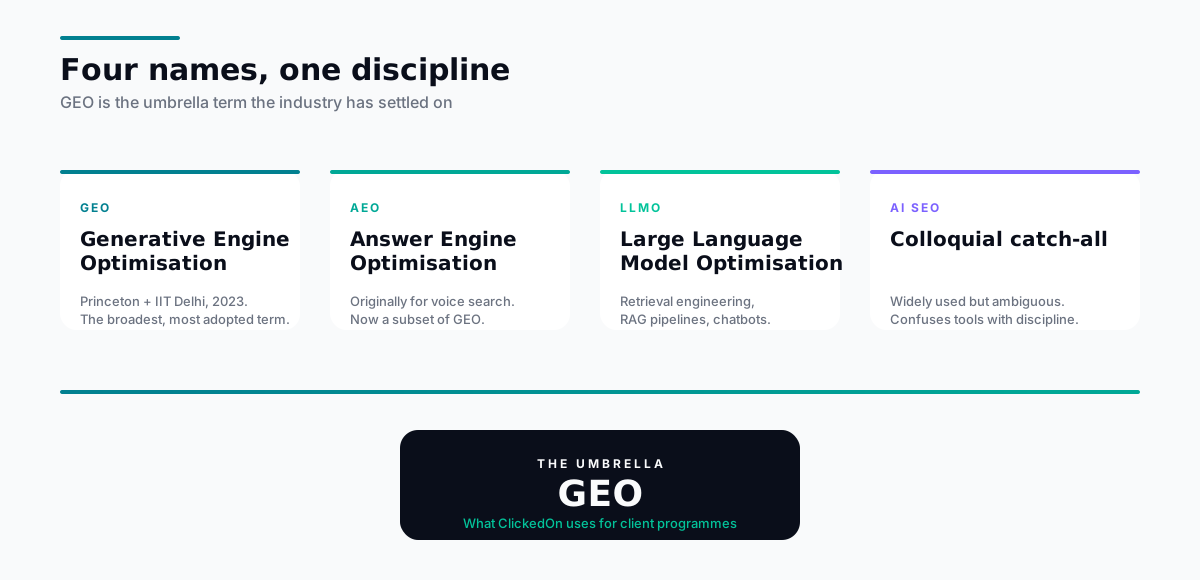
The discipline of optimising content for AI-generated answers has at least half a dozen names circulating right now. GEO (Generative Engine Optimisation) is the most widely adopted term, used by Princeton/IIT Delhi researchers and the GEO Conference series. AEO (Answer Engine Optimisation) was originally coined for voice search and is now largely subsumed by GEO. LLMO (Large Language Model Optimisation) is technically precise but narrow, focusing on LLMs specifically rather than the broader AI search ecosystem. AI SEO is the colloquial catch-all, widely understood but can confuse AI-powered SEO tools with the discipline itself.
At ClickedOn, we use GEO (Generative Engine Optimisation) as the primary term. Our working definition: GEO is the practice of structuring your content and digital presence so that AI-powered platforms (ChatGPT, Google AI Overviews, Perplexity, Claude, Gemini, and others) can retrieve, cite, and recommend your brand when answering user questions.
We chose GEO because it has the strongest academic foundation, the most industry traction, and a dedicated conference series. But honestly, the name matters less than what you do with it. Whatever you call the discipline, the work is the same.
How GEO differs from traditional SEO
Traditional SEO optimises for ranking positions in a list of links. GEO optimises for citations within AI-generated answers. A page can rank number one in Google but never get cited by ChatGPT if it lacks the structural elements AI engines prioritise. Discovery has changed. Instead of competing for 10 blue links, you're competing for inclusion among the two to seven sources an AI typically cites in a single answer. Intent signals have changed. Users no longer type "best CRM software" into a search bar; they ask an AI more nuanced questions. Success metrics have changed. Rankings still matter, but you also need to track citations, brand mentions in AI responses, and share of voice across multiple AI platforms.
What still works from traditional SEO
A significant amount of what made good SEO effective still applies. Authority and trust still drive visibility. High-domain-authority sites earn three times more AI citations than lower-authority sites, according to SE Ranking's analysis of 2.3 million pages. Technical SEO remains the foundation. E-E-A-T has not gone away. Quality content still wins. Brand building is more important than ever. AI engines recommend brands they "know."
The building blocks of AI visibility
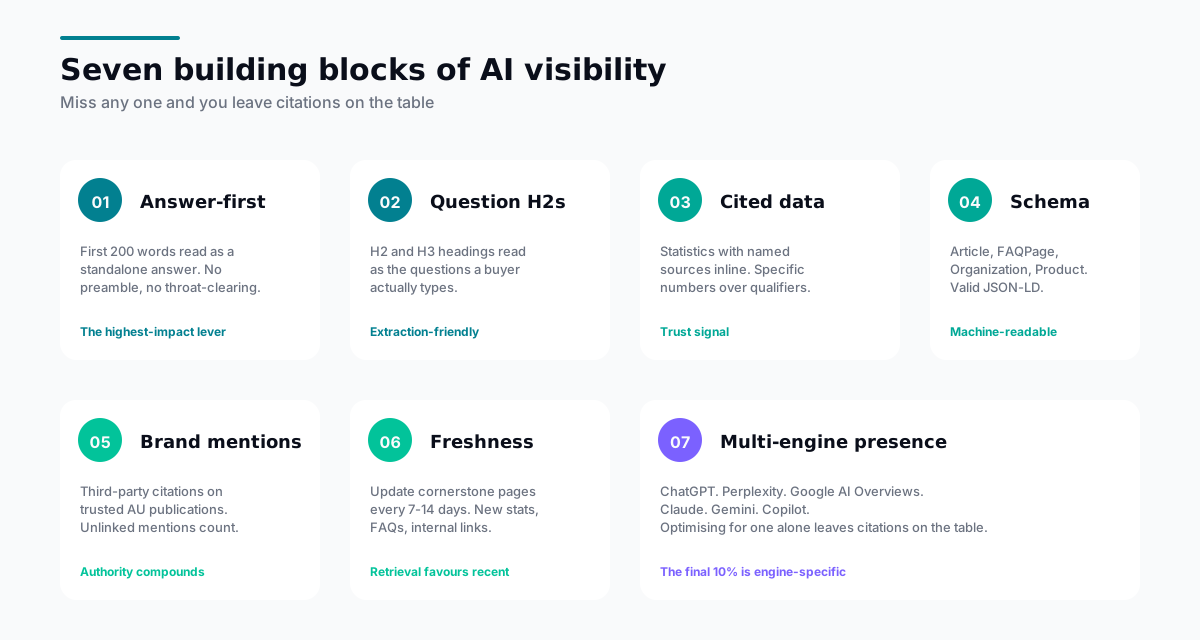
The building blocks of AI visibility include: answer-first content structure (the first 200 words should directly answer the primary question), question-format headings (H2 and H3 headings as actual questions), specific and citable data (statistics with named sources), structured data and schema markup, third-party brand mentions across trusted industry sites, content freshness (update cornerstone content every seven to 14 days), and multi-platform presence across ChatGPT, Perplexity, Google AI Overviews, and Claude.
Common mistakes businesses make
Common mistakes businesses make include treating GEO as a replacement for SEO (more than 76% of URLs cited in Google's AI Overviews also rank in the top 10 organic results), ignoring the shift because AI traffic is "small" (it grew 527% in a year and converts at 4.4x the rate), optimising for one platform only, and publishing content shaped for browsing rather than extraction.
Getting started with GEO
If you are not sure where to start, audit your current AI visibility by searching for your brand in ChatGPT, Perplexity, and Google AI Mode. Then restructure your top ten highest-traffic pages with answer-first introductions and question-format headings. Strengthen your technical foundation, build citation authority through industry publications, set up measurement in GA4, and commit to regular content freshness.
Frequently asked questions
What is GEO and why does it matter in 2026?
GEO (Generative Engine Optimisation) is the practice of structuring your content and digital presence so AI platforms like ChatGPT, Google AI Overviews, Perplexity, Claude, Gemini and Copilot can retrieve, cite and recommend your brand. It matters because AI-referred sessions grew 527% year-on-year in 2025, those sessions convert at 4.4x to 10x the rate of traditional organic traffic, and Gartner projects traditional search volume will drop 25% by the end of 2026. If your business is not being cited inside AI answers, a competitor will be.
Is GEO the same as AEO or LLMO?
GEO is the broadest term and the one most widely adopted. AEO (Answer Engine Optimisation) is a subset focused on content structure for extractable answers. LLMO (Large Language Model Optimisation) is a subset focused on retrieval engineering for RAG pipelines and pure LLM use cases. See our full AEO vs GEO vs LLMO breakdown for the practical differences.
Does GEO replace traditional SEO?
No. SE Ranking's analysis of 2.3 million pages found that 76% of URLs cited in Google AI Overviews also rank in the top ten organic results. Classic SEO fundamentals remain the foundation. GEO adds answer-first content structure, schema markup, citation authority and content freshness on top of solid SEO. Treating GEO as a replacement is one of the most expensive mistakes we see.
How do I measure GEO performance?
Measure three things monthly. Citation share across ChatGPT, Perplexity, Google AI Overviews, Claude, Gemini and Copilot (run the same twenty baseline prompts each month, on the same day). AI-referred sessions and conversions inside GA4, with referral tracking set up for chatgpt.com, perplexity.ai, claude.ai and gemini.google.com. Sentiment and factual accuracy of your brand's AI mentions. Our free AI Visibility Audit automates a snapshot across all the major engines.
How long does a GEO programme take to show results?
With the groundwork in place (answer-first rewrites, clean schema, indexed pages), citation movement typically shows within four to eight weeks. Consistent inclusion in category answer sets takes three to four months. Full compounding (being cited alongside category leaders by default across every major engine) usually takes six to nine months. GEO rewards consistency more than effort bursts.
What is the first thing I should do?
Rewrite the first 200 words of your top ten pages as a direct, self-contained answer to the primary query. Then deploy Article, FAQPage and Organization schema across those pages using our free schema generator. That single sequence (content plus schema on cornerstone pages) moves the needle faster than anything else in the first month.
Key takeaways
- GEO is the practice of earning brand citations, mentions and recommendations inside AI answers. It is the umbrella term the industry has settled on.
- AI-referred traffic grew 527% year-on-year in 2025 and converts at 4.4x to 10x the rate of classic organic. The business case does not depend on absolute volume.
- Classic SEO is still the foundation. 76% of URLs cited inside Google AI Overviews also rank in the top ten organic results.
- Seven building blocks matter: answer-first structure, question-format headings, cited data, schema markup, third-party brand mentions, content freshness, and multi-engine presence.
- The biggest mistakes are treating GEO as a replacement for SEO, ignoring the shift because AI traffic looks small today, optimising for a single engine, and writing content shaped for browsing rather than extraction.
- Being visible during the early LLM conversation is the point. The buyer who arrives from ChatGPT or an Overview has already made up their mind.
Where to start
Whether the answer comes from Google search results or an AI-generated response, ClickedOn helps businesses stay discoverable. If you want a baseline, our free GEO Readiness Checker scores your domain against the technical and structural factors that drive citation in under a minute. It gives you the gaps.
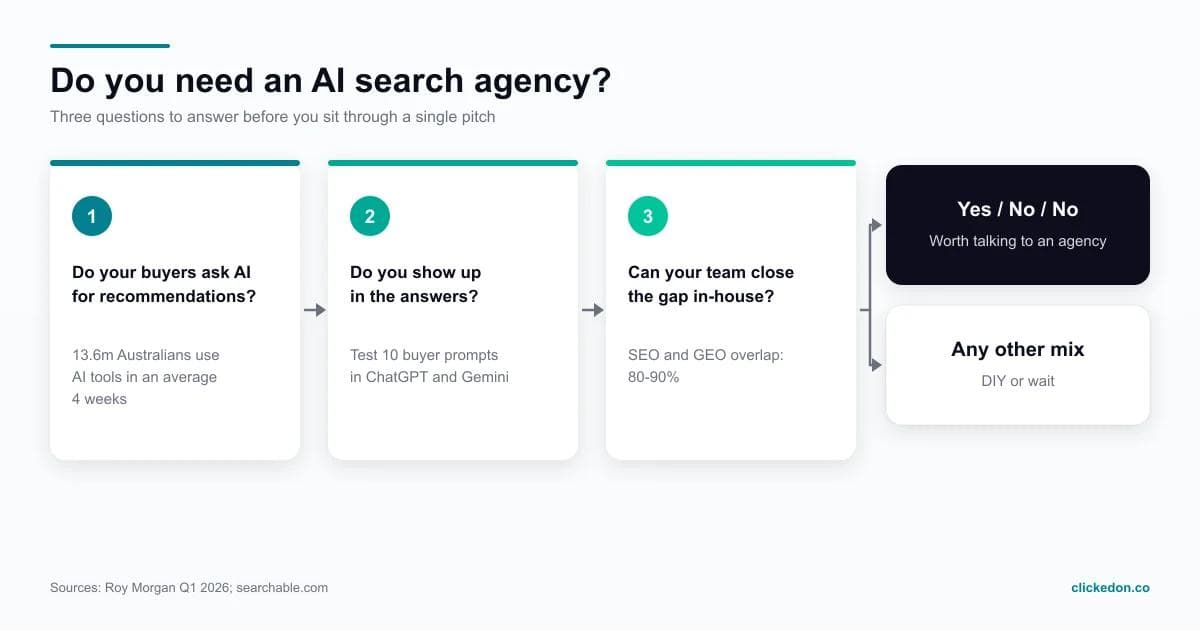
If the scale of the rewrite, the tracking cadence or the citation workstream is bigger than what you can run internally, that is usually the right time to bring in a partner. We have been running GEO as a managed programme for Australian enterprise clients since early 2025. Have a look at what we do, or connect with us to build a strategy that works across both traditional search and generative engines.