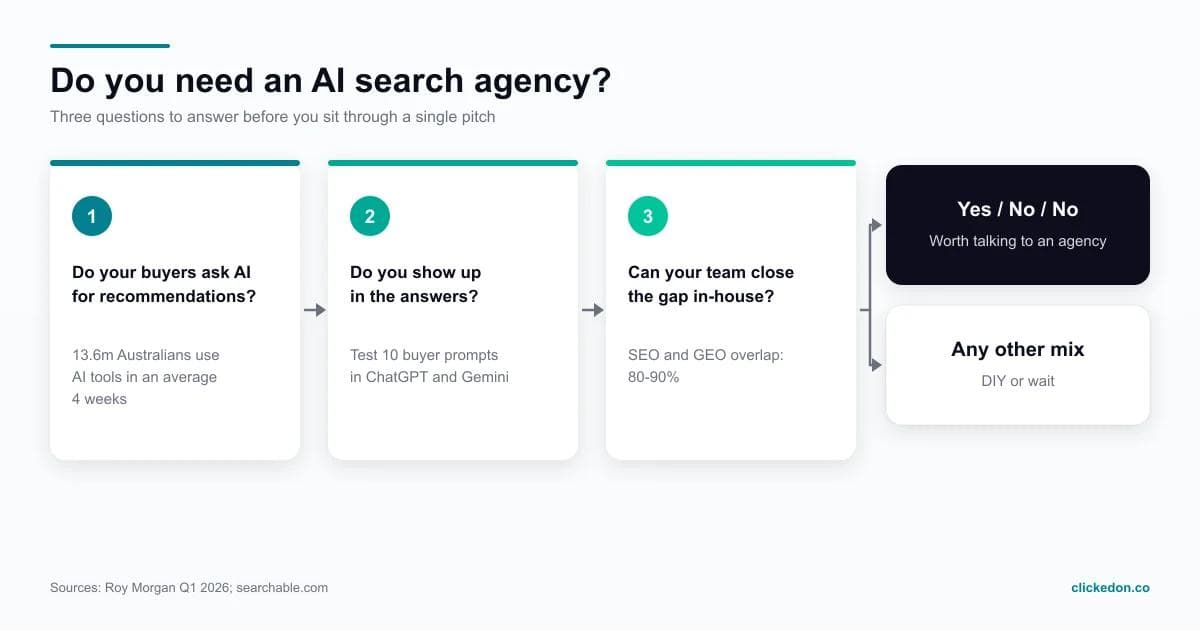
You need an AI search agency if three things are true: your buyers ask ChatGPT, Gemini, or Google's AI Overviews for recommendations, your brand is missing from the answers, and you don't have the team to fix that yourselves. If any one of those is false, you probably don't need one yet. This guide helps you work out which camp you're in before you sit through a single pitch.
The pressure to decide is real. Roy Morgan's Q1 2026 survey of 14,646 Australians found 13.6 million of us (58% of everyone 14 and over) use AI tools in an average four weeks. In ClickedOn client data, visitors from AI answers convert at 4.4 times the rate of traditional organic visitors. Numbers like these have spawned a crowded GEO agency market almost overnight, and quality varies wildly. Plenty of what's being sold is a 2023 SEO retainer with new headings. And nobody, anywhere, can guarantee your brand a placement inside ChatGPT.
One disclosure first. I founded ClickedOn, and we sell GEO services. That makes me a biased narrator. Read this guide with that in mind, and use every question and test in it on us as hard as on anyone else.
This guide is written for in-house marketing managers at Australian mid-market businesses who keep hearing about AI search and want a straight answer before taking vendor calls. It covers who needs help, who doesn't, how to vet, what to measure, and what to pay. If your real question is whether to build the capability internally, read it alongside our in-house versus agency breakdown.
What does an AI search agency actually do?
An AI search agency works to get your brand cited and recommended inside AI-generated answers. You'll see it called GEO (generative engine optimisation), AEO, or LLMO, and the three labels overlap almost completely. Whatever the label on the proposal, the work should be five things: tracking the prompts your buyers ask across ChatGPT, Gemini, Perplexity, and AI Overviews; restructuring key pages so a model can lift the answer straight out; deploying schema; earning brand mentions on publications the models trust; and reporting citation share monthly. Our plain-English guide to GEO covers the full discipline.
Why did this become a job at all? Because ranking well no longer gets you cited. Ahrefs studied 863,000 keywords in March 2026 and found only 38% of Google AI Overview citations now come from top-10 organic results, down from 76% in July 2025. The old scoreboard and the new one are drifting apart. Quickly.
How do I know if my business actually needs one?
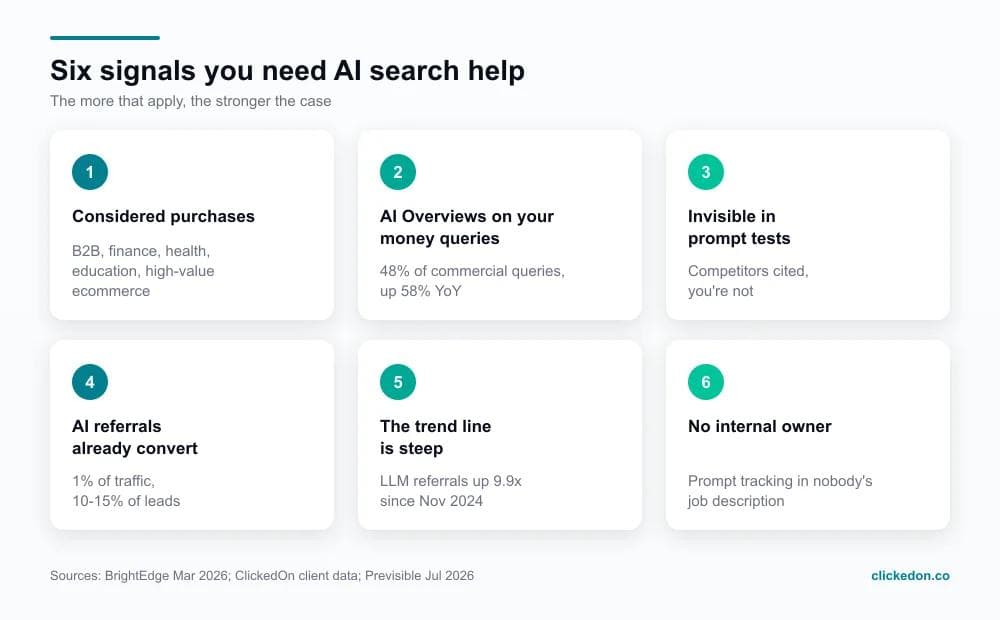
We've run this qualification with prospective clients since early 2025. It comes down to six signals. The more that apply, the stronger the case.
- Your buyers make considered purchases. B2B services, finance, health, education, higher-value ecommerce: the categories where buyers ask AI for shortlists.
- AI answers already sit on your money queries. BrightEdge found AI Overviews on roughly 48% of tracked commercial queries in March 2026, up 58% year on year. Search yours and look.
- You've tested the prompts and you're invisible. Ask ChatGPT and Gemini to recommend providers in your category. If competitors appear and you don't, that's the business case in one screenshot.
- AI referrals are already in your GA4, and they convert. In our client data, AI-referred sessions are about 1% of traffic but drive 10 to 15% of leads once assisted conversions are counted.
- The trend line is steep. Previsible's July 2026 AI Traffic Report (166 GA4 properties, 6.77 million LLM sessions) found LLM referrals grew 9.9x from November 2024 to May 2026, with ChatGPT driving 92.4%.
- Nobody internally owns it. Your SEO resource is at capacity, and prompt tracking, citation outreach, and content restructuring sit in nobody's job description.
Just as important: you probably don't need an agency if:
- You're a local service business fed by the map pack. If plumbing or dental leads come from Google Maps and reviews, keep investing there. AI assistants lean on the same local signals.
- You have a capable SEO team with headroom. The SEO and GEO overlap is roughly 80 to 90% by searchable.com's estimate. A good team can extend into prompt tracking and answer-first structure on its own.
- Your buyers aren't using AI search yet. Check GA4 for referrals from chatgpt.com, perplexity.ai, gemini.google.com, and copilot.microsoft.com. If nothing shows and your category adopts slowly, waiting is legitimate.
- Your basic SEO is broken. No citation programme gets around a slow site, thin content, or crawl errors. GEO sits on top of SEO fundamentals, not instead of them.
Before you talk to anyone, us included, run our free GEO readiness check. It takes about a minute and tells you which list you're on.
What separates a good GEO agency from a rebadged SEO retainer?
The uncomfortable truth about this market: it's barely three years old, there's no accreditation, and the barrier to entry is a slide deck. I've read proposals where the only change from the agency's 2023 SEO template was the acronym. The overlap with SEO is genuinely large, so the question isn't whether an agency does SEO things. It's whether they can show you what's new.
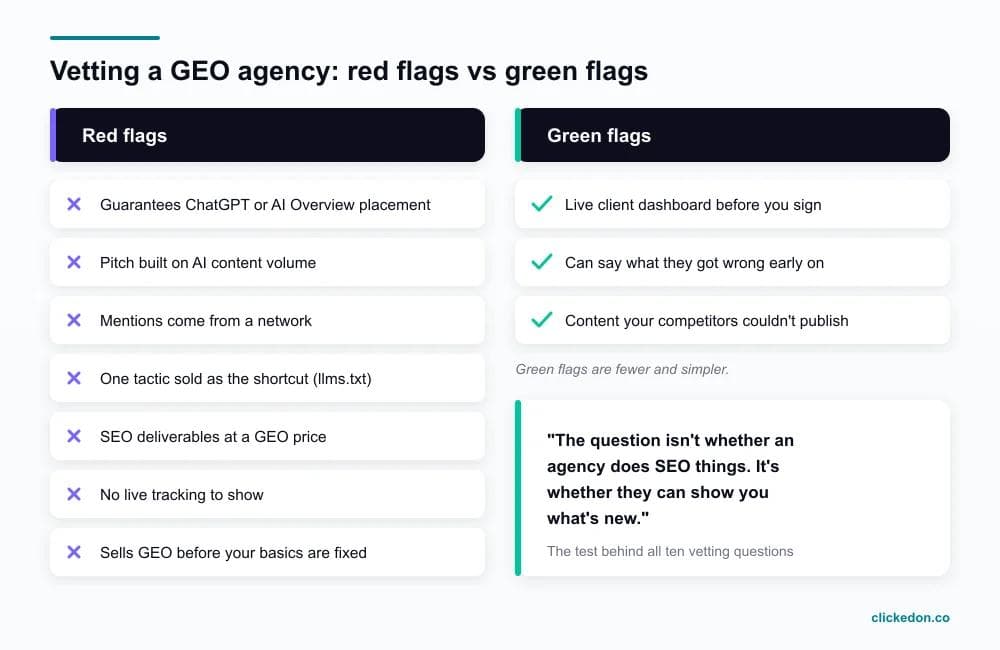
Red flags, all of which we've seen in the wild:
- They guarantee citations or placement in ChatGPT or AI Overviews. Nobody controls model output. Disqualifying on its own.
- The pitch centres on AI content volume. Thirty generated articles a month maps directly onto Google's scaled content abuse policy, and it hurts you on both scoreboards.
- Mentions come from a network. Ask where citations come from, and whether you'd be comfortable if a buyer traced them back. Silence is an answer.
- A single tactic is sold as the shortcut, llms.txt being the current favourite. It's hygiene at best, not a strategy.
- Same deliverables, higher price. If the scope reads exactly like SEO, pay SEO prices or walk.
- They can't show live tracking. No citation dashboard, no sample report. In 2026 that's an ad agency that can't show you a campaign.
- They'll sell you GEO while your foundations are broken. A good agency tells you to fix site speed, reviews, and crawlability first, even when it delays their own start date.
Green flags are fewer and simpler. They show you a live client dashboard, anonymised, before you sign. They can tell you when they started testing GEO and what surprised them. And they can point to a piece of client content competitors couldn't publish, built on the client's own data.
What questions should I ask before signing?
Take these to the meeting. Ask them in order. The point isn't to catch anyone out. The shape of the answers tells you whether you're talking to practitioners or salespeople.
1. "What will you do for us that an SEO retainer wouldn't?" A good answer names new deliverables: prompt tracking across specific engines, answer-first rewrites, citation outreach to named publications. "AI-powered SEO" is not an answer.
2. "Which prompts will you track, and how many?" A good answer is 20 to 30 buyer-intent prompts, agreed with you before month one, tracked across ChatGPT, Gemini, Perplexity, and AI Overviews.
3. "Can I see a live dashboard from a current client?" A good answer is a screen share in the meeting, anonymised. A PDF mock-up is not a dashboard.
4. "When did you start doing this, and what has changed in your approach since?" A good answer includes at least one thing they got wrong. No mistakes means no history.
5. "How will we know by day 90 whether it's working?" A good answer commits to a baseline in month one and measurable citation movement by month three, without promising specific placements.
6. "Can you guarantee we'll appear in ChatGPT or AI Overviews?" A good answer is a flat no, followed by what they can control. Anything else, end the meeting politely.
7. "Where will our citations and mentions come from?" A good answer names real publications and an earned outreach process. If you hear "our network", ask whether a buyer tracing those mentions would like what they find.
8. "How much of the retainer is content production versus structure, authority, and measurement?" A good answer has content as one workstream among several, not the whole invoice.
9. "Who owns the content, the dashboards, and the data if we leave?" A good answer is you, all of it, published on your domain, with tracking history exported on exit.
10. "What do you need from us for this to work?" A good answer asks for subject-matter expert time, developer access, and fast approvals. "Nothing, we handle everything" means generic output is coming.
How should I measure a GEO agency?
Insist on a baseline before the retainer starts. Not after month one. If an agency can't tell you where you stand today, they can't prove they moved anything.
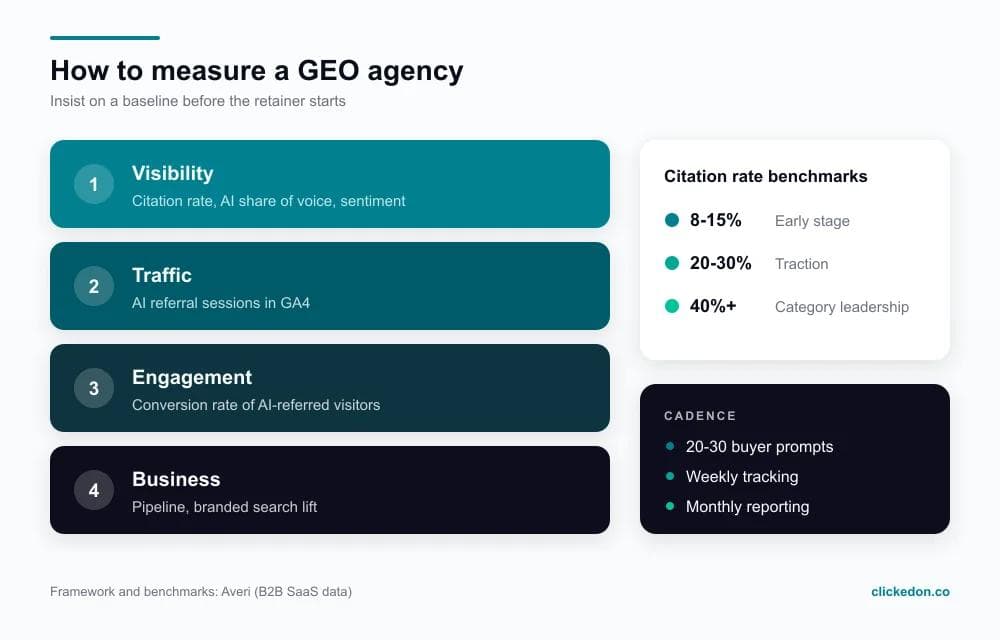
We hold ourselves to averi.ai's four-layer framework, and it's a sensible standard for any agency:
- Visibility. Citation frequency across your tracked prompts, AI share of voice against named competitors, and the sentiment and accuracy of what the models say about you.
- Traffic. AI referral sessions in GA4 from the major assistant domains.
- Engagement. Conversion rate of AI-referred visitors: form fills, demo requests.
- Business. AI-attributed pipeline and branded search lift, the lagging indicators that justify the spend.
Weekly prompt tracking, monthly reporting. We run client prompt sets weekly because single runs mislead: models personalise, and answers wobble day to day. Averi's B2B SaaS benchmarks help set expectations: 8 to 15% citation rate is early stage, 20 to 30% is real traction, 40% or more is category leadership. In 90 days you should see the baseline built, the content shipped, and the citation rate moving off its floor. Not leadership. Movement.
One honest caveat. Per-platform conversion attribution is still unsolved, and Previsible's July 2026 report calls it the field's biggest open question. An agency presenting ChatGPT-attributed revenue to the dollar is over-claiming.
Tools you should hear named in the meeting: Profound, Ahrefs Brand Radar, Scrunch, AthenaHQ, Semrush's AI Visibility Toolkit, SE Ranking's AI tracker. Our free AI visibility audit gives you a snapshot to bring along as your own baseline. No sign-up.
What should I expect to pay?
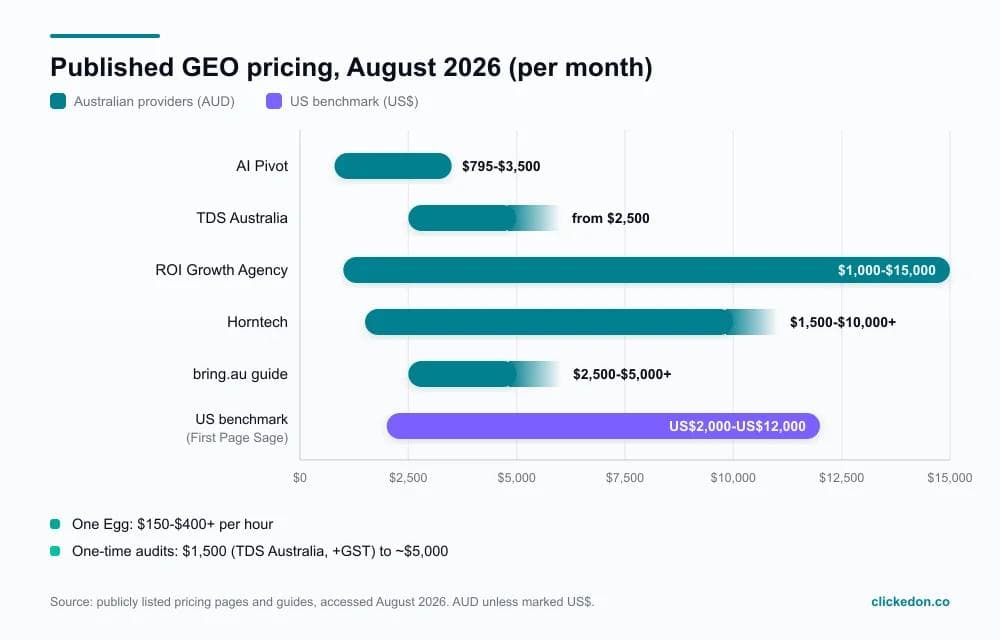
Few agencies publish GEO pricing, which itself tells you how young the market is. Here's what the ones that do are charging, as at August 2026.
In Australia, AI Pivot's published tiers run $795 to $3,500 a month (the entry tier includes four articles a month, schema work, and citation monitoring). TDS Australia lists a one-time audit at $1,500 plus GST and retainers from $2,500 a month. ROI Growth Agency in Melbourne publishes a range of $1,000 to $15,000 a month. Horntech's Sydney cost guide puts working budgets at $1,500 to $10,000+ a month, and One Egg lists hourly rates of $150 to $400+. bring.au's 2026 guide lands dedicated GEO programmes at $2,500 to $5,000+ a month, audits from about $1,500. In the US, First Page Sage's November 2025 tiers run US$2,000 to US$12,000 a month depending on scope.
For context, typical Australian SEO retainers sit at $1,500 to $5,000+ a month, and Ahrefs' 2024 survey of 439 providers put the global average at US$2,917 a month. GEO pricing is converging on the same band.
What moves the price: prompt and engine coverage, content production volume, category competitiveness, and whether citation outreach is a managed workstream or an afterthought. Be suspicious of the offer at a few hundred dollars a month, well under every published floor above. That price only works with automated content and recycled mention networks, the two things most likely to get you filtered out of the models.
Run the in-house comparison too. Monitoring tools are cheap: Otterly.ai from about $29 a month, Semrush's AI Visibility Toolkit US$99, Profound US$99 to US$399, AthenaHQ US$295, Ahrefs Brand Radar a US$199 add-on. The tooling was never the moat. The scarce input is a person who can write answer-first content, earn citations, and hold a weekly cadence. If you have that person a day or two a week, do it in-house.
Frequently asked questions
How much does a GEO agency cost in Australia?
Published Australian pricing runs from $795 to $3,500 a month at AI Pivot, from $2,500 at TDS Australia, and up to $15,000 at the top of ROI Growth Agency's range. One-time audits typically cost $1,500 to $5,000. Most dedicated programmes land at $2,500 to $5,000 a month, in line with bring.au's 2026 guide.
Do I still need traditional SEO if I invest in GEO?
Yes. GEO sits on top of SEO foundations, and the overlap is roughly 80 to 90% by searchable.com's estimate. But ranking alone is no longer enough. Ahrefs found only 38% of Google AI Overview citations now come from top-10 organic results, down from 76% in July 2025. You need both, run as one programme.
Can my current SEO agency just do GEO?
Sometimes. The skills transfer, but the deliverables are new: prompt tracking across AI engines, answer-first restructuring, citation outreach, and AI referral reporting. Ask them the ten questions in this guide, especially the live dashboard one. Specific answers mean extending the relationship is often cheaper than adding a second agency.
How long does GEO take to show results?
Expect a measured baseline in month one and citation movement within 60 to 90 days. Consistent inclusion in your category's answer sets typically takes six to nine months, because authority signals compound slowly. An agency promising placements in weeks is guessing, or worse.
How do I measure a GEO agency's performance?
Across four layers: visibility (citation rate and AI share of voice on 20 to 30 tracked prompts), traffic (AI referral sessions in GA4), engagement (conversion rate of AI-referred visitors), and business impact (pipeline and branded search lift). Weekly tracking, monthly reporting. Averi's B2B SaaS benchmarks: 8 to 15% citation rate is early, 20 to 30% is traction, 40% or more is leadership.
Key takeaways
- You need help if buyers ask AI for recommendations, you're absent from the answers, and nobody internally can fix it. Otherwise wait or do it yourself.
- 13.6 million Australians use AI tools in an average four weeks (Roy Morgan, Q1 2026), and in ClickedOn client data, visitors from AI answers convert at 4.4 times the rate of traditional organic visitors.
- Ranking is no longer the same as being cited: 38% of AI Overview citations come from top-10 organic results, down from 76% (Ahrefs, March 2026).
- The GEO agency market is young and full of rebadged SEO retainers. Anyone guaranteeing placement in ChatGPT is disqualified on the spot.
- Published Australian pricing runs $795 to $3,500+ a month, with most dedicated programmes at $2,500 to $5,000. Audits run $1,500 to $5,000.
- Run the free self-checks before any agency call. Including ours.
Where to start
Not with a pitch meeting. Start with twenty minutes of your own testing: run our free GEO readiness check and AI visibility audit, then ask ChatGPT and Gemini for recommendations in your category. You'll walk into any vendor call knowing your baseline, and that changes the meeting.
If the tests show a gap and you have the team, run it in-house first. Nothing in GEO is secret. If the gap is real and the capacity isn't, shortlist two or three agencies and take the ten questions with you. We'd like to be on that shortlist. We've run GEO as a managed programme for Australian clients since early 2025, we've been a Google Premier Partner five years running, and what we'd show you in that meeting is the same live tracking this article tells you to demand. Have a look at what our GEO agency actually does, or send us a note.
And if we ever fail one of the ten questions above, tell me. I wrote them.