
To brief an agency for AI search, put six things in writing: a commercial goal, a fixed prompt set, technical access rules, a content scope, reporting requirements, and contract terms. The brief will shape the result more than the shortlist will. Google says pages need nothing special to appear in AI Overviews beyond being indexed and eligible for a snippet. So pay for measurement and content, and walk away from anyone selling mystery tactics.
This guide is for Sydney marketing leads and founders who are setting 2027 budgets, where AI search is now a line item the board asks about by name. Plenty of the briefs that reach a GEO agency like ours are one sentence long: "get us showing up in ChatGPT". That gives an agency nothing to be measured against, and every proposal you receive ends up looking the same.
How do you brief an agency for AI search? The quick answer
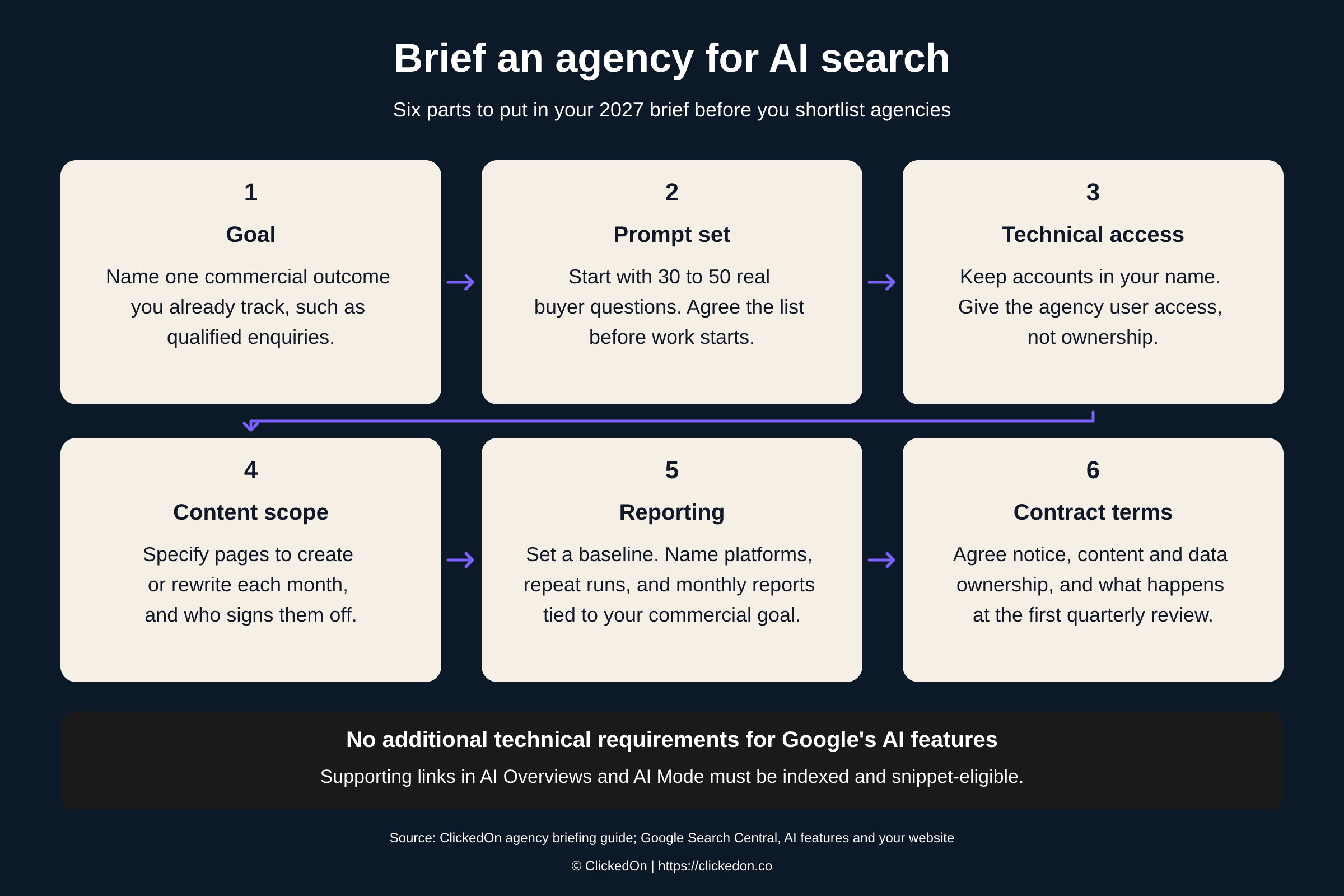
A brief that holds an agency to account has six parts:
- Goal: one commercial outcome you already track, such as demo bookings or qualified enquiries for a named service line.
- Prompt set: a fixed list of real questions your buyers ask AI tools, agreed before work starts. We recommend starting with 30 to 50.
- Technical access: which accounts the agency can use, and which stay in your name.
- Content scope: how many pages get created or rewritten each month, and who signs them off.
- Reporting: what gets measured, on which platforms, and how often.
- Contract terms: notice period, who owns the content and data, and what happens at the first quarterly review.
What are you actually paying for?
GEO (generative engine optimisation) is the work of getting your brand cited, mentioned or recommended inside AI answers from ChatGPT, Google AI Overviews, Perplexity, Gemini and Copilot. The industry has no settled name for it. AEO, LLMO and AI SEO describe overlapping slices of the same work, so judge proposals on scope, not the label.
Some proposals gloss over the next part. Google Search Central states that to appear as a supporting link in AI Overviews or AI Mode, a page must be indexed and eligible to show a snippet. Google lists no additional technical requirements.
That puts most of an AI search programme in classic SEO territory: crawlable, indexed pages with content that answers the buyer's question near the top. Our view is that the budget belongs in measurement and content. If a proposal leans on proprietary "AI signals" it cannot explain, treat that as a sales line.
If your site has indexing problems today, an AI search retainer is premature. A focused technical SEO engagement is the better first spend, and your current agency may handle it perfectly well. Our technical SEO checklist lists the checks to run first.
Which prompts should the brief cover?
In classic SEO you briefed keywords. In AI search you brief prompts: the full questions people type into ChatGPT, Perplexity and Google. Write them in your customers' words and mix the types.
Here is a worked example for a hypothetical Sydney rostering software company:
- Category: "best rostering software for a hospitality group in Sydney"
- Comparison: "[competitor] alternatives for cafés with several sites"
- Problem: "how do I roster casual staff around award rates in NSW"
- Brand: "is [your brand] good for venues with 50 staff"
Category and comparison prompts usually sit closest to revenue, so weight your list toward them. Keep a core set fixed for at least a year so the trend lines mean something. Track new prompts in a separate list.
This is where we would cut any GEO agency shortlist. If an agency cannot name the prompts it will track before you sign, rule it out. Without a list there is no baseline, and without a baseline every monthly report becomes a story instead of a measurement.
Which accounts stay in your name?
Agencies should get user access to your accounts, never ownership. Before work starts, confirm you are the owner on:
- Google Search Console and Google Analytics 4
- your CMS, domain registrar and DNS
- Google Business Profile, if you serve local customers
- your ChatGPT Business Hub profile (covered below)
Then check what your robots.txt file and any CDN or firewall settings do with AI crawlers. Blocking them is a legitimate choice. It should be made on purpose, though, not inherited from a setting nobody remembers switching on. Our free GEO Readiness Checker spots the obvious gaps before an agency sees the site.
How should results be measured and reported?
Ask for a baseline before any content changes. For each prompt, on each platform, the report should record whether your brand is cited with a link, mentioned without one, or missing. It should also name the competitors that appear instead.
AI answers vary between runs, so ask how many times each prompt is run and how often. A single screenshot of ChatGPT citations proves very little.
Monthly reports should then show movement on that same prompt set beside the commercial goal from your brief, such as enquiries from AI referral traffic in GA4. If your AI search visibility rises and enquiries don't, you want to know early.
How long before results show? Anyone quoting a fixed date is guessing, because the platforms do not publish how they choose sources. Agree a review at the end of the first quarter, judged on the trend across the whole set.
Where does ChatGPT Business Hub fit in the brief?
OpenAI opened Businesses in ChatGPT in beta on 10 November 2026. Its dashboard, Business Hub, lets a verified business manage its profile and see how often ChatGPT refers to it. For the first time, part of your baseline can come from OpenAI's own numbers and not only from third-party tracking.
This week we finished setting it up for two clients as part of their AI search optimisation work, after claiming our own profile earlier in the month. The steps ran like this:
- Decide which ChatGPT account will own the profile. We recommend a work account inside your business, not the agency's.
- Go to chatgpt.com/business-hub, find your business and start the claim.
- Choose website domain verification. ChatGPT gives you a TXT record, and whoever manages your DNS adds it. Neither your marketing team nor your agency can do this step without DNS access, so it is where most of the waiting happens.
- Once the record is live, go back to ChatGPT and select Verify domain.
- Complete the identity check. The person claiming needs photo ID and a camera.
- Invite your agency as a user, so the numbers feed weekly work and monthly reports.
Once verified, the Insights view shows mentions, profile views and website clicks for the last 7 or 28 days. It also lists your top discovery topics: the themes of the ChatGPT answers that cited your business.
Read those numbers with OpenAI's definitions beside you:
- For an online business, a mention counts only when ChatGPT references your website. The brand name alone does not count.
- Discovery topics are themes, not prompts. You will not see what people typed.
- A blank metric can mean activity sits below OpenAI's reporting threshold. It does not mean zero.
- Claiming a profile does not make ChatGPT recommend you more often. OpenAI says so directly.
Two things follow for your brief. The profile belongs in your name with the agency invited as a user, the same as Search Console. And Business Hub covers one platform, in themes, so it sits beside your prompt set and does not replace it. Ask for both in the monthly report. Our ChatGPT Business Hub setup guide walks through each step, with the traps we hit.
Which questions should you ask before you sign?
| Question | Good answer | Red flag |
|---|---|---|
| Which prompts will you track? | A written list, agreed with you | "We monitor your AI visibility" with no list |
| How do you measure citations? | Named platforms, repeat runs, exportable data | One proprietary score with no method behind it |
| What will you change on our site? | Named pages and a monthly content volume | Special markup or "signals" they cannot explain |
| Who owns the content and data? | You do, including after you leave | Reports that live only inside their platform |
| Who owns our ChatGPT Business Hub profile? | You do, with the agency invited as a user | The agency claims it under its own account |
| What can you promise? | A process, a baseline and a review date | Promised citations or top placement in ChatGPT |
The last row matters for more than taste. Nobody controls what an AI model says on a given day. Promising specific placement also sits uneasily with section 18 of the Australian Consumer Law, which prohibits misleading or deceptive conduct. A good agency will tell you what it can influence and what it can't.
Frequently asked questions
What should an AI search agency brief include?
Six parts: one commercial goal you already track, a fixed prompt set, technical access rules, a monthly content scope, reporting requirements, and contract terms. The prompt set matters most, because it is the list every later report gets measured against.
How many prompts should an AI search brief include?
Start with 30 to 50 real buyer questions, written in your customers' words. Weight the list toward category and comparison prompts, which usually sit closest to revenue. Keep a core set fixed for at least a year so the trend lines mean something.
Can our current SEO agency handle AI search?
Often, yes. Google says a page needs only to be indexed and eligible for a snippet to appear in AI Overviews, so most of the work is classic SEO done well. What changes is the measurement: prompt tracking across AI platforms and reporting on citations. Our guide on whether you need an AI search agency lists the questions to ask yours.
Can an agency guarantee we appear in ChatGPT?
No. Nobody controls what an AI model says on a given day, and OpenAI states that even claiming your business profile does not guarantee more visibility. An agency can commit to a process, a baseline and a review date. Treat promised citations or top placement as a red flag.
How long does AI search work take to show results?
Nobody can quote a reliable date, because the platforms do not publish how they choose sources. Agree a baseline in the first month and a review at the end of the first quarter. Judge progress on the trend across the whole prompt set, not on one answer.
Should ChatGPT Business Hub be part of the brief?
Yes. Claim the profile under an account your business owns, then invite the agency as a user. Ask for its mentions, website clicks and discovery topics in each monthly report, alongside your prompt tracking. It covers ChatGPT only and shows themes, not individual prompts.
Key takeaways
- A useful brief has six parts: goal, prompt set, technical access, content scope, reporting, and contract terms.
- The prompt set carries the brief. Rule out any agency that cannot name the prompts it will track before you sign.
- Google says pages only need to be indexed and snippet eligible to appear in AI Overviews, so most of the spend belongs in measurement and content.
- Keep ownership of Search Console, GA4, your CMS, your domain and your ChatGPT Business Hub profile. Agencies get user access only.
- Business Hub gives you OpenAI's own counts of mentions, clicks and discovery topics. Use it beside your prompt set, not in place of it.
- Judge progress at a quarterly review on the trend across the whole prompt set, tied to a commercial number you already track.
Where to start
The prompt set and baseline are far easier to write when you know how AI answers treat your brand today. Run our free AI Visibility Audit and take the results into your 2027 brief.
If you would rather hand the brief to a team that has held Google Premier Partner status for five consecutive years, see how our GEO services work, or tell us about your 2027 plans.